
Filed under: Case Files | Cryptid Cynic
Every cryptid on this site has a moment where the modern legend actually began, separate from any older folklore that might have existed before it. For Nessie, that moment is remarkably precise: 1933, when a new road was built along the northern shore of Loch Ness, suddenly giving drivers a clear, unobstructed view of the water for the first time in the loch’s history. Sightings exploded almost immediately afterward. That’s not a coincidence anyone tries very hard to hide — it’s on the record, in the actual local newspapers of the era. And yet, ninety-plus years, one of the most famous photographic hoaxes in history, multiple sonar expeditions, and a full-blown environmental DNA study later, we’re still talking about this lake like it might be hiding something. Let’s find out why.
The Older Legend, Briefly
Before we get to 1933, it’s worth noting Loch Ness folklore didn’t spring from nothing — a 6th-century biography of Saint Columba describes him supposedly banishing a “water beast” from the River Ness in 565 AD. This gets cited constantly as evidence of an ancient, unbroken tradition, but it deserves real skepticism on its own terms: medieval saints’ biographies are absolutely stuffed with miraculous beast-banishing stories as a standard hagiographic device, used to demonstrate a saint’s holiness, not as literal wildlife reporting. Treating a 6th-century religious text as a credible eyewitness cryptid sighting is a stretch that even most Nessie believers don’t lean on heavily anymore, and we won’t either.
The real modern legend starts with that 1933 road.
The Photo That Built an Industry
In 1934, a London surgeon named Robert Kenneth Wilson published a photograph showing what appeared to be a long, curved neck and small head rising from the water — the image that, more than any other single artifact, defined what “the Loch Ness Monster” is supposed to look like in the public imagination. The “Surgeon’s Photograph” ran in newspapers worldwide and became the template silhouette for the entire legend.
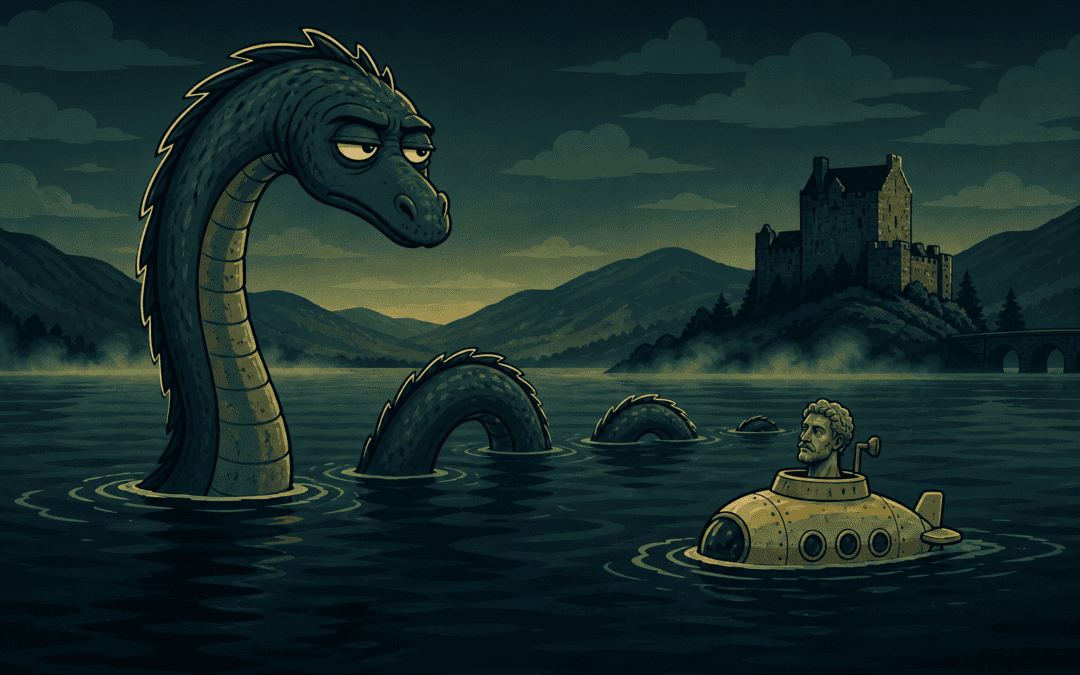
In 1994, decades after the fact, it was definitively revealed as a hoax — a small sculpted head and neck mounted on a toy submarine, built by a man named Christian Spurling, at the instigation of a group that included Marmaduke Wetherell, a big-game hunter who had been publicly humiliated earlier that year after “monster tracks” he’d found and reported turned out to be made with a hippo-foot ashtray stand. The whole thing was reportedly staged as revenge against the newspaper that had mocked him. This is, genuinely, one of the greatest details in all of cryptid history: the most famous monster photograph on Earth exists because a guy got embarrassed by a hippo-foot ashtray and wanted to save face.
We’re leading with this not to dunk on Nessie believers, but because it’s important context for everything that follows: the legend’s most iconic single image is a confirmed, admitted fraud, built out of petty revenge, not mistaken identity or genuine belief. That’s a different category of “debunked” than most cryptid photos get, and it’s worth being upfront about it.
So Why Didn’t the Legend Die With the Photo?
This is the actually interesting part. A legend built on a confirmed hoax photograph should, by all reasonable logic, have collapsed the moment that hoax came to light. It didn’t, because — and this is true of Nessie more than almost any other cryptid on this site — the 1934 photo was never the only evidence people were working from. Sightings had already been rolling in for a full year before Wilson’s photo existed, from ordinary residents with no financial stake in the story, and they kept rolling in for decades after the hoax was exposed, largely unaffected by the revelation. That’s a meaningfully different pattern than a legend that depends entirely on one faked artifact — the fraud discredited a specific piece of media, not the underlying phenomenon of “people keep seeing something in this lake.”
The Sonar Era: 1950s Through Today
Loch Ness has been hit with more serious scientific instrumentation than arguably any other cryptid location on Earth, and that’s genuinely to its credit as a research subject, whatever you conclude from the results.
Robert Rines, an MIT-trained patent attorney and inventor, ran multiple sonar and underwater photography expeditions starting in the 1970s, and one 1972 sonar/photography combination produced an image that Rines and his team interpreted as showing a large, diamond-shaped flipper. It’s genuinely one of the more serious pieces of Nessie evidence ever produced, backed by real instrumentation and a credentialed researcher rather than a random tourist snapshot — and it’s also been criticized extensively for image enhancement techniques of the era that some analysts argue introduced artifacts that weren’t in the raw data, essentially “finding” a flipper shape in enhanced noise. The debate over this specific image has never fully settled either way, which is a genuinely unsatisfying but accurate summary.
Operation Deepscan in 1987 deployed a coordinated flotilla of boats with sonar equipment sweeping the entire loch simultaneously — one of the most serious, well-funded search efforts ever mounted for any cryptid, anywhere. It picked up a few unexplained sonar contacts at depth, but nothing conclusive, and no follow-up visual or physical evidence was ever obtained to clarify what those contacts were. “A few weird sonar blips, no confirmation” isn’t nothing, but it’s a far cry from proof, and researchers involved have been candid about that gap ever since.
The eDNA Study: The Most Scientifically Rigorous Attempt Yet
This is the one that deserves the most attention and gets the least mainstream coverage, and it’s genuinely fascinating regardless of which side of this debate you’re on. In 2018-2019, a team led by geneticist Neil Gemmell conducted a comprehensive environmental DNA survey of Loch Ness — taking water samples throughout the loch and sequencing the genetic material shed by every organism living in or passing through the water, a technique with real, validated scientific applications well beyond cryptid research (it’s used seriously in conservation biology to survey species presence without physical capture).
The results, published in 2019, found no genetic evidence of any large, unknown species, plesiosaur-like reptile, or unclassified organism in the loch. What the study did find, in genuinely large quantities, was eel DNA — a huge amount of it, present throughout the loch at every depth sampled. Gemmell himself, notably, didn’t dismiss the phenomenon outright; he specifically raised the possibility that an unusually large eel, or a population of eels reaching greater size than typically documented, could account for at least some sighting reports, given how much eel genetic material was present relative to other species. This is actually a satisfying, scientifically grounded partial answer that gets underreported compared to the flashier “Nessie is fake” headline the study generated — the honest conclusion is closer to “no unknown giant reptile, but also an unexpectedly large amount of unaccounted-for eel biomass in a loch people have been reporting a serpentine creature in for ninety years,” which is a genuinely interesting, if less thrilling, place to land.
The Boring (But Real) Explanations for Most Individual Sightings
Loch Ness has a specific set of well-documented mundane phenomena that account for a large share of reported sightings, and they’re worth knowing because they show up in the vast majority of photographic “Nessie” claims when examined closely. Standing waves and seiches — a kind of internal water oscillation caused by wind and the loch’s unusual depth and shape — can produce moving humps and wakes on the surface with no animal involved at all. Floating logs, waterlogged and partially submerged, are extremely common in the loch due to the surrounding pine forests, and a partially sunk log riding just below the surface produces a shape and wake pattern that matches a huge number of reported sightings almost exactly. And boat wakes, particularly from the loch’s active tourist boat traffic, can create long, low, serpentine-looking wave patterns that are frequently misidentified when viewed from a distance or at an odd angle, especially by someone already primed by the loch’s reputation to interpret ambiguous shapes generously.
What We Actually Think
We think the honest, current scientific position is this: there is no large unknown species living in Loch Ness, and the most rigorous, most modern piece of evidence — a genuinely serious genetic survey of the entire loch — found nothing to support one. What we do think is genuinely interesting, and gets buried under the “Nessie debunked” headlines, is that the eDNA study didn’t produce a fully boring answer either: it left real, unresolved questions about eel biomass and size in the loch that nobody had good data on before, and those questions are worth someone following up on for their own sake, independent of monster hunting.
Ninety years in, the most famous monster photo in history is a confirmed fraud born out of a grudge over a hippo ashtray, and the most sophisticated genetic survey ever conducted on the loch found no cryptid — just an unexpected abundance of a fish nobody was thinking about. That’s not the ending anyone wanted when this story started. But it might be the most honest one this genre has produced yet.
Next up: we head to the Pine Barrens of New Jersey, where a 260-year-old legend has been blamed for basically everything strange that’s ever happened in that forest.