by chris | Aug 12, 2026 | Crypid
Filed under: Case Files | Cryptid Cynic
Every region needs a designated “weird stuff happens here” explanation, and New Jersey’s Pine Barrens got theirs earlier and more thoroughly than almost anywhere else in America. The Jersey Devil — a creature description so specific and so bizarre that it’s genuinely hard to compare to any other entry on this site — has been the go-to explanation for over 260 years of odd noises, strange tracks, and things going missing in a 1.1-million-acre pine forest that, even today, remains one of the most sparsely populated and genuinely eerie wilderness areas on the entire East Coast.
The Origin Legend
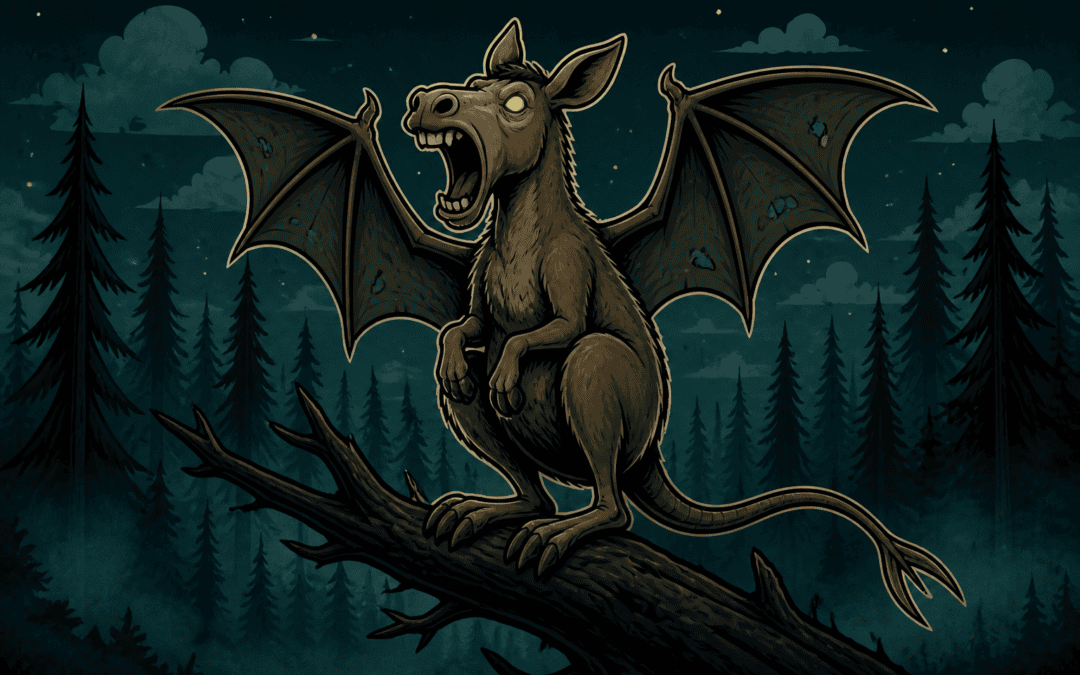
The most commonly told version dates the creature’s birth to 1735, and it’s worth telling in full because it’s genuinely one of the strangest founding myths of any cryptid, period. According to the legend, a woman named Mother Leeds (sometimes given the first name Deborah), already exhausted from raising twelve children in the Pine Barrens, discovered she was pregnant with a thirteenth and reportedly cursed the child during a difficult labor, supposedly crying out that the baby could “be the devil” for all she cared. The child was allegedly born looking normal, then transformed almost immediately — growing hooves, wings, a horse-like or goat-like head, and a forked tail — before killing the midwife and flying up the chimney to disappear into the Pine Barrens, where it’s supposedly lived and terrorized the region ever since.
We want to be completely clear about something before going further: there’s no contemporary 1735 documentation of this event actually happening. This origin story is folklore in the truest sense — an oral tradition that was written down and popularized much later, almost certainly evolving and getting embellished across generations before anyone put it on paper. Some historians have also proposed a more grounded, considerably less supernatural theory for where the story actually came from: a real historical figure, Daniel Leeds, was a colonial-era almanac publisher whose work included astrological symbols and content that devout Quaker neighbors in the area found genuinely offensive and borderline heretical for the time. Leeds became locally unpopular enough that some historians suspect the “Leeds Devil” legend may have originated, at least partly, as folk mockery or genuine local suspicion directed at the Leeds family specifically, later merging with the more elaborate supernatural birth-curse narrative as it spread. If true, this would make the Jersey Devil one of the rare cryptids with a plausible origin rooted in actual small-town interpersonal drama rather than a monster sighting at all — which is, frankly, a very New Jersey way for a legend to start.
The Physical Description, and Why It’s So Specific
Unlike Bigfoot or most lake monsters, where descriptions vary fairly widely between witnesses, the Jersey Devil’s description has stayed remarkably consistent across nearly three centuries: a creature roughly the size of a large dog or small kangaroo, standing or hopping bipedally, with leathery bat-like wings, a horse- or goat-like elongated head, cloven hooves, small clawed forelimbs, and a long, thin, forked tail. It’s frequently described as making a distinctive, high-pitched shrieking or screaming sound before or during a sighting. That level of cross-witness consistency over multiple centuries is genuinely unusual in this genre — it suggests either a remarkably stable, deeply embedded regional folklore template that gets applied consistently to ambiguous sightings (the far more likely explanation), or, if you’re inclined to be generous to the believers, a genuinely consistent unknown species with a stable, recognizable physical profile passed down through repeated real encounters. We lean heavily toward the former, but the consistency itself is worth acknowledging as a genuinely interesting feature of the case.
The 1909 Sighting Panic — The Actual Historical Peak of This Story
If the 1735 birth story is folklore, the January 1909 “Jersey Devil sighting week” is very much real, documented history, and it’s the actual reason this legend has the staying power it does. Over roughly a week, newspapers across the greater Philadelphia and South Jersey region reported an extraordinary wave of sightings and strange track discoveries — hundreds of claimed encounters across multiple towns, some from credible sources including police officers and postmasters, describing a creature matching the traditional description. Schools in several towns closed due to widespread public fear. Posses were organized to hunt the creature. A reward was reportedly offered by a Philadelphia entertainment promoter for its capture (a detail that should immediately raise your skepticism, given how directly it incentivized false claims and copycat reports for financial gain).
This week of intense, well-documented regional panic is genuinely one of the best-recorded mass cryptid events in American history — comparable in scale and documentation quality to the Flatwoods and Mothman cases we’ve covered, but happening decades earlier and getting far less modern attention, which is exactly the gap we’re trying to fill with this piece. Contemporary newspaper accounts, strange tracks found in snow across multiple towns, and a genuine, verifiable week of public terror are all real historical facts, independent of what actually caused them.
The Skeptical Case
Given the timing — deep winter, snow on the ground, a promoter openly offering money for a captured specimen — the 1909 panic has several very plausible mundane drivers that deserve serious weight. Media contagion is an obvious and well-supported factor: once the story ran in one paper, competing papers across the region had commercial incentive to report their own local sightings, real or embellished, and that kind of newspaper-driven copycat reporting cycle is well documented in other historical panics of the era, unrelated to any cryptid. Misidentified wildlife tracks in snow — particularly from kangaroos, several of which had genuinely escaped from a private menagerie and traveling circus in the region around this general period, a detail cryptid researchers frequently cite — could plausibly explain both the described bipedal hopping gait and the otherwise unusual track patterns reported in multiple towns. And a cash reward openly offered for the creature’s capture is about as clean an incentive for hoaxed sightings and fabricated tracks as this genre ever produces.
What We Actually Think
We think the Jersey Devil is best understood less as a single creature-identification mystery and more as a genuinely fascinating case study in how folklore, regional identity, and media incentives compound over centuries to build something that outlives any single explanation. The 1735 origin is almost certainly folklore, possibly rooted in real small-town grudges against an unpopular colonial publisher. The 1909 panic is real, well-documented history, almost certainly amplified by newspaper competition and a genuinely bad-incentive cash reward, on top of a plausible misidentified-wildlife baseline (hello again, escaped kangaroos).
But 260-plus years is a long time for a story to survive purely on newspaper competition and colonial grudges, and the Pine Barrens themselves — genuinely remote, genuinely strange, one of the largest under-populated forest tracts left on the entire Eastern Seaboard — have never stopped producing the occasional strange sighting report, right up to the present day. We don’t think there’s a leathery-winged, cloven-hoofed creature living in the Pine Barrens. We do think New Jersey deserves more credit for having, quietly, one of the oldest, weirdest, and most historically well-documented cryptid legends in the entire country, and getting a fraction of the pop-culture attention Mothman or Bigfoot get for it.
by chris | Aug 10, 2026 | Crypid
Filed under: Case Files | Cryptid Cynic
Every cryptid on this site has a moment where the modern legend actually began, separate from any older folklore that might have existed before it. For Nessie, that moment is remarkably precise: 1933, when a new road was built along the northern shore of Loch Ness, suddenly giving drivers a clear, unobstructed view of the water for the first time in the loch’s history. Sightings exploded almost immediately afterward. That’s not a coincidence anyone tries very hard to hide — it’s on the record, in the actual local newspapers of the era. And yet, ninety-plus years, one of the most famous photographic hoaxes in history, multiple sonar expeditions, and a full-blown environmental DNA study later, we’re still talking about this lake like it might be hiding something. Let’s find out why.
The Older Legend, Briefly
Before we get to 1933, it’s worth noting Loch Ness folklore didn’t spring from nothing — a 6th-century biography of Saint Columba describes him supposedly banishing a “water beast” from the River Ness in 565 AD. This gets cited constantly as evidence of an ancient, unbroken tradition, but it deserves real skepticism on its own terms: medieval saints’ biographies are absolutely stuffed with miraculous beast-banishing stories as a standard hagiographic device, used to demonstrate a saint’s holiness, not as literal wildlife reporting. Treating a 6th-century religious text as a credible eyewitness cryptid sighting is a stretch that even most Nessie believers don’t lean on heavily anymore, and we won’t either.
The real modern legend starts with that 1933 road.
The Photo That Built an Industry
In 1934, a London surgeon named Robert Kenneth Wilson published a photograph showing what appeared to be a long, curved neck and small head rising from the water — the image that, more than any other single artifact, defined what “the Loch Ness Monster” is supposed to look like in the public imagination. The “Surgeon’s Photograph” ran in newspapers worldwide and became the template silhouette for the entire legend.
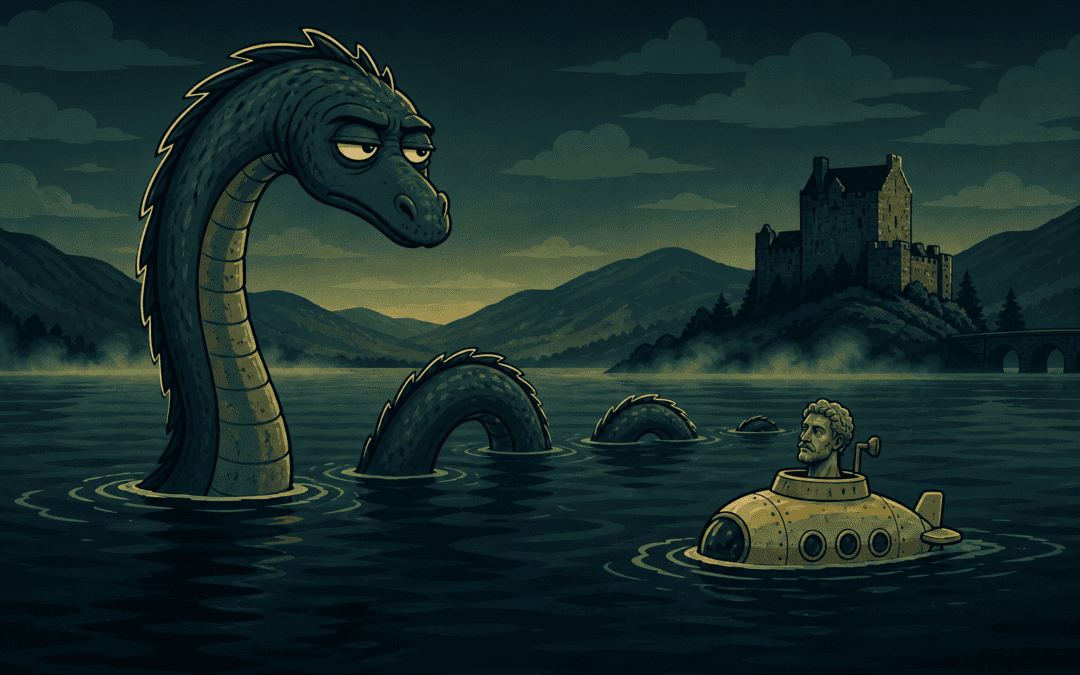
In 1994, decades after the fact, it was definitively revealed as a hoax — a small sculpted head and neck mounted on a toy submarine, built by a man named Christian Spurling, at the instigation of a group that included Marmaduke Wetherell, a big-game hunter who had been publicly humiliated earlier that year after “monster tracks” he’d found and reported turned out to be made with a hippo-foot ashtray stand. The whole thing was reportedly staged as revenge against the newspaper that had mocked him. This is, genuinely, one of the greatest details in all of cryptid history: the most famous monster photograph on Earth exists because a guy got embarrassed by a hippo-foot ashtray and wanted to save face.
We’re leading with this not to dunk on Nessie believers, but because it’s important context for everything that follows: the legend’s most iconic single image is a confirmed, admitted fraud, built out of petty revenge, not mistaken identity or genuine belief. That’s a different category of “debunked” than most cryptid photos get, and it’s worth being upfront about it.
So Why Didn’t the Legend Die With the Photo?
This is the actually interesting part. A legend built on a confirmed hoax photograph should, by all reasonable logic, have collapsed the moment that hoax came to light. It didn’t, because — and this is true of Nessie more than almost any other cryptid on this site — the 1934 photo was never the only evidence people were working from. Sightings had already been rolling in for a full year before Wilson’s photo existed, from ordinary residents with no financial stake in the story, and they kept rolling in for decades after the hoax was exposed, largely unaffected by the revelation. That’s a meaningfully different pattern than a legend that depends entirely on one faked artifact — the fraud discredited a specific piece of media, not the underlying phenomenon of “people keep seeing something in this lake.”
The Sonar Era: 1950s Through Today
Loch Ness has been hit with more serious scientific instrumentation than arguably any other cryptid location on Earth, and that’s genuinely to its credit as a research subject, whatever you conclude from the results.
Robert Rines, an MIT-trained patent attorney and inventor, ran multiple sonar and underwater photography expeditions starting in the 1970s, and one 1972 sonar/photography combination produced an image that Rines and his team interpreted as showing a large, diamond-shaped flipper. It’s genuinely one of the more serious pieces of Nessie evidence ever produced, backed by real instrumentation and a credentialed researcher rather than a random tourist snapshot — and it’s also been criticized extensively for image enhancement techniques of the era that some analysts argue introduced artifacts that weren’t in the raw data, essentially “finding” a flipper shape in enhanced noise. The debate over this specific image has never fully settled either way, which is a genuinely unsatisfying but accurate summary.
Operation Deepscan in 1987 deployed a coordinated flotilla of boats with sonar equipment sweeping the entire loch simultaneously — one of the most serious, well-funded search efforts ever mounted for any cryptid, anywhere. It picked up a few unexplained sonar contacts at depth, but nothing conclusive, and no follow-up visual or physical evidence was ever obtained to clarify what those contacts were. “A few weird sonar blips, no confirmation” isn’t nothing, but it’s a far cry from proof, and researchers involved have been candid about that gap ever since.
The eDNA Study: The Most Scientifically Rigorous Attempt Yet
This is the one that deserves the most attention and gets the least mainstream coverage, and it’s genuinely fascinating regardless of which side of this debate you’re on. In 2018-2019, a team led by geneticist Neil Gemmell conducted a comprehensive environmental DNA survey of Loch Ness — taking water samples throughout the loch and sequencing the genetic material shed by every organism living in or passing through the water, a technique with real, validated scientific applications well beyond cryptid research (it’s used seriously in conservation biology to survey species presence without physical capture).
The results, published in 2019, found no genetic evidence of any large, unknown species, plesiosaur-like reptile, or unclassified organism in the loch. What the study did find, in genuinely large quantities, was eel DNA — a huge amount of it, present throughout the loch at every depth sampled. Gemmell himself, notably, didn’t dismiss the phenomenon outright; he specifically raised the possibility that an unusually large eel, or a population of eels reaching greater size than typically documented, could account for at least some sighting reports, given how much eel genetic material was present relative to other species. This is actually a satisfying, scientifically grounded partial answer that gets underreported compared to the flashier “Nessie is fake” headline the study generated — the honest conclusion is closer to “no unknown giant reptile, but also an unexpectedly large amount of unaccounted-for eel biomass in a loch people have been reporting a serpentine creature in for ninety years,” which is a genuinely interesting, if less thrilling, place to land.
The Boring (But Real) Explanations for Most Individual Sightings
Loch Ness has a specific set of well-documented mundane phenomena that account for a large share of reported sightings, and they’re worth knowing because they show up in the vast majority of photographic “Nessie” claims when examined closely. Standing waves and seiches — a kind of internal water oscillation caused by wind and the loch’s unusual depth and shape — can produce moving humps and wakes on the surface with no animal involved at all. Floating logs, waterlogged and partially submerged, are extremely common in the loch due to the surrounding pine forests, and a partially sunk log riding just below the surface produces a shape and wake pattern that matches a huge number of reported sightings almost exactly. And boat wakes, particularly from the loch’s active tourist boat traffic, can create long, low, serpentine-looking wave patterns that are frequently misidentified when viewed from a distance or at an odd angle, especially by someone already primed by the loch’s reputation to interpret ambiguous shapes generously.
What We Actually Think
We think the honest, current scientific position is this: there is no large unknown species living in Loch Ness, and the most rigorous, most modern piece of evidence — a genuinely serious genetic survey of the entire loch — found nothing to support one. What we do think is genuinely interesting, and gets buried under the “Nessie debunked” headlines, is that the eDNA study didn’t produce a fully boring answer either: it left real, unresolved questions about eel biomass and size in the loch that nobody had good data on before, and those questions are worth someone following up on for their own sake, independent of monster hunting.
Ninety years in, the most famous monster photo in history is a confirmed fraud born out of a grudge over a hippo ashtray, and the most sophisticated genetic survey ever conducted on the loch found no cryptid — just an unexpected abundance of a fish nobody was thinking about. That’s not the ending anyone wanted when this story started. But it might be the most honest one this genre has produced yet.
Next up: we head to the Pine Barrens of New Jersey, where a 260-year-old legend has been blamed for basically everything strange that’s ever happened in that forest.
by chris | Aug 8, 2026 | Crypid
Filed under: Case Files | Cryptid Cynic
West Virginia has, by any reasonable accounting, punched wildly above its weight in the cryptid department. We’ve already covered Mothman, the state’s marquee export, terrifier of Point Pleasant, star of its own movie. But nine years before Mothman ever showed up, a small town called Flatwoods produced its own encounter — arguably stranger, considerably better-witnessed at the time, and somehow almost nobody outside serious cryptid circles has ever heard of it. That’s a genuine oversight, and we’re here to fix it.
September 12, 1952: A Very Bad Night to Be Curious
The story starts, as so many of these do, with kids and a light in the sky. A group of boys playing football in Flatwoods, a small town in Braxton County, saw what they described as a bright object streak across the sky and appear to land on a nearby hilltop property owned by a local farmer, Bailey Fisher. This alone isn’t unusual — bright meteors get misreported as “landing” nearby constantly, an important detail we’ll return to. What makes this case different is what happened next: the boys ran home, and instead of the story dying there, they recruited more witnesses.
The group that headed up the hill to investigate wasn’t a couple of overexcited kids — it eventually included Kathleen May (a local woman and mother of two of the boys), a 17-year-old National Guardsman named Eugene Lemon, several other neighborhood children, and Lemon’s dog, which reportedly ran ahead of the group and began barking wildly before promptly running back, distressed enough that it stands out as a genuine data point in an era before anyone was trying to embellish animal reactions for internet clout.
What They Actually Reported
At the top of the hill, in fog and near a foul, metallic-smelling mist that multiple witnesses independently described as making their eyes and throats burn (a detail worth sitting with — that’s a specific, consistent physical sensation reported across multiple people, not just a visual claim), the group’s flashlights reportedly illuminated a tall figure near the tree line. Descriptions varied slightly across witnesses, as they always do, but the core account was remarkably consistent: a towering figure, estimated at seven to ten feet tall, with a dark or metallic-looking body, and a distinctive spade-shaped or hood-like head with two glowing eye-like openings. Some witnesses described the lower portion of the figure as appearing to float or hover rather than showing visible legs, folded like drapery or a skirt-like base.
Lemon reportedly screamed and the group fled the hillside immediately. Several members of the group, including May and some of the children, later reported physical symptoms in the following hours and days — nausea, vomiting, and throat irritation, severe enough that a local doctor examined multiple witnesses and, per contemporary reports, attributed the symptoms to a form of nervous hysteria brought on by fright rather than any external toxin, though this diagnosis has been revisited skeptically many times since, for reasons we’ll get into.
The National Guardsman Detail Actually Matters
It’s worth pausing on something easy to skim past: one of the primary witnesses wasn’t a child prone to imaginative storytelling, but a 17-year-old enlisted National Guardsman, a demographic not typically associated with fabricating monster encounters for attention, especially in a small, socially conservative 1952 Appalachian town where that kind of story could plausibly damage your reputation rather than build a following. That doesn’t make the account true. But it’s a meaningfully different credibility profile than “anonymous internet post,” and deserves more weight than it usually gets in casual retellings.
The Skeptical Case (Given Its Full Due)
Let’s do our job properly, because this case has a genuinely strong mundane explanation on the table, and pretending otherwise would be dishonest.
The night of September 12, 1952 coincided with a real, documented meteor event — bright fireballs were reported across multiple states that evening, giving a very plausible mundane origin for the “object landing on the hill” portion of the story. A bright meteor, especially one that appeared to terminate near the observer’s horizon due to perspective, is a well-documented source of “something landed over there” reports, even though meteors that appear to land nearby are almost always burning up at high altitude, many miles away, with no actual physical touchdown anywhere near the observer.
The “monster” sighting itself has a genuinely compelling competing explanation, and it’s more specific and satisfying than most skeptical takes in this genre: researcher Joe Nickell proposed in the early 2000s that the entire figure could be explained by a barn owl, perched on a branch at height in fog and darkness, with its face illuminated from below by the witnesses’ own flashlights — owl faces, lit from underneath in exactly this way, can appear strikingly humanoid, with the classic heart-shaped facial disc resembling a “hood,” and the eyes producing the reported glow through the same eyeshine phenomenon we covered in our Mothman piece (a barn owl doesn’t have eyeshine quite like a nocturnal mammal, but the flashlight-and-fog combination has been demonstrated to produce a very similar disorienting effect in reconstructed conditions). The apparent height estimate, exaggerated under fright and poor visibility, and the “floating” lower body, potentially explained by fog obscuring where legs or a branch actually met the ground, round out a genuinely coherent alternative explanation that doesn’t require dismissing any single witness as lying.
The burning eyes and throat irritation are also explainable without anything exotic: some researchers have proposed the group may have wandered into a patch of ground vegetation or a natural gas seep common to the region, or simply experienced a documented physiological stress response, hyperventilation and panic bringing on nausea and throat tightness independent of any external chemical cause. None of these require coordination between witnesses or bad faith from anyone involved — just fear, fog, poor lighting, and a startled group of people encountering an unfamiliar bird at the worst possible moment.
Why This Case Deserves More Attention, Regardless of What It Was
Here’s the actual point of this piece, and it’s less about “was it real” and more about “why doesn’t anyone talk about this one.” The Flatwoods case has genuinely unusual features that separate it from the average cryptid report: a same-night astronomical event that’s independently verifiable through historical records, multiple witnesses with real, checkable identities (not anonymous forum posts), consistent physical symptom reports across separate individuals, and a specific, well-reasoned mundane explanation (the owl-in-fog theory) that’s more detailed and testable than “eh, probably a bear” — the lazy default explanation applied to half the cases in this genre.
That combination — strong witness credibility, a real astronomical anchor event, physical symptoms worth taking seriously, and a genuinely thoughtful skeptical counter-theory — is more than most far more famous cases can claim. Mothman gets the movie. Roswell gets the merchandise. Flatwoods gets… occasionally mentioned in passing on cryptid podcasts, and that’s about it. We think that’s a genuine miscarriage of cryptid-content justice, and we’re doing our small part to correct it.
What We Actually Think
We think the barn-owl-in-fog theory is a strong, well-reasoned explanation and probably the closest thing to a real answer this case has — Joe Nickell did his homework, and “startled group encounters unfamiliar large bird under terrible visibility conditions right after a genuinely frightening meteor event” checks nearly every box the evidence presents. But we also think “well-reasoned mundane explanation” and “case fully closed” aren’t the same thing, especially given how specific and consistent the physical symptom reports were across multiple independent people, which the owl theory explains less cleanly than it explains the visual sighting itself.
Either way: this is a genuinely interesting, under-covered piece of American cryptid history, and if you’re only aware of West Virginia’s paranormal reputation through Mothman, you’re missing half the story. Flatwoods deserves its own footnote in the culture, at minimum. Consider this our attempt to give it one.
by chris | Aug 8, 2026 | Crypid
Filed under: Case Files | Cryptid Cynic
Every cryptid has a hook. Bigfoot’s hook is “big, hairy, shy.” The Loch Ness Monster’s hook is “old lake, big lake, murky water, use your imagination.” Mothman’s hook is considerably weirder and, frankly, more disturbing: a red-eyed, winged humanoid that showed up in a small West Virginia town for about thirteen months, terrified a string of ordinary people, and then — this is the part that actually separates Mothman from every other cryptid on this list — was allegedly connected to a real, deadly disaster that happened right after it left.
That’s not normal cryptid lore. That’s the plot structure of a horror movie, except it happened, on the record, to real people, in Point Pleasant, West Virginia, starting in November 1966.
The First Sighting (Or: A Bad Night for Two Couples)
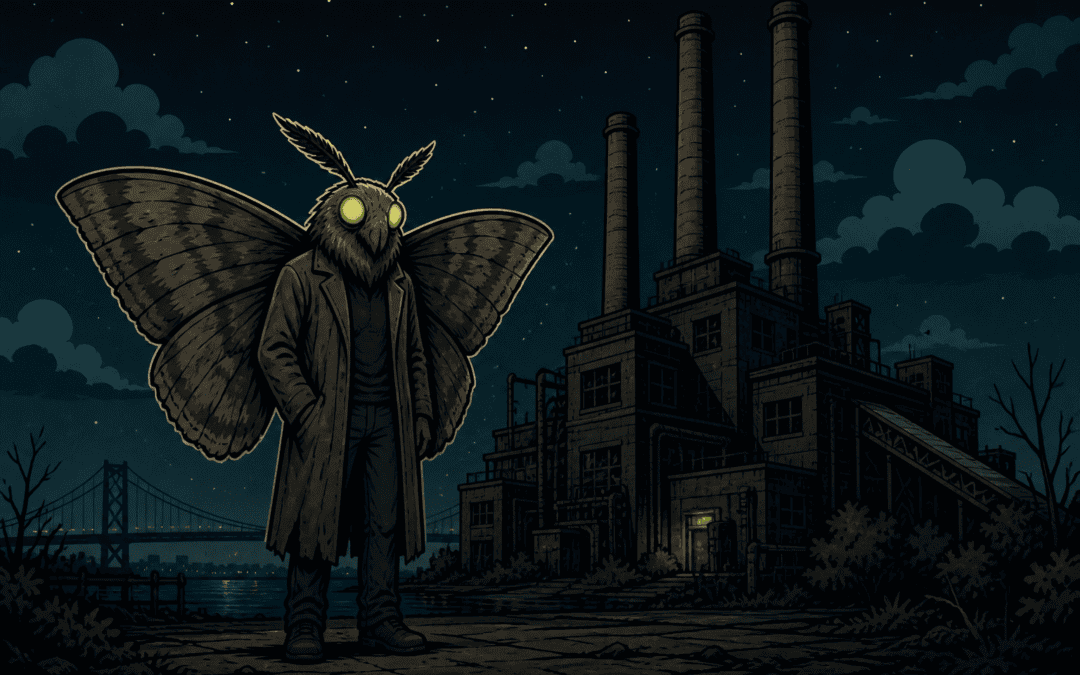
On November 15, 1966, two young couples — Roger and Linda Scarberry, and Steve and Mary Mallette — were driving through an abandoned World War II munitions site known locally as the “TNT area,” just outside Point Pleasant. According to their account, they saw a large gray figure with glowing red eyes standing near an old power plant building. When they tried to drive away, they claimed the creature followed — not by walking, but by flying, low over their car, at speeds they estimated (almost certainly with some panic-inflated math, and we’ll get to that) at up to 100 miles per hour, without ever flapping its wings.
They went straight to the local sheriff’s office, visibly terrified, which is itself worth noting — these weren’t people looking for attention or trying to sell a story. They were, by every contemporary account, badly shaken. The sheriff’s deputies searched the TNT area and found nothing, but the story got out, and within days, more sightings started rolling in from other locals: similar descriptions, similar location, similar overwhelming sense of dread that witnesses struggled to articulate beyond “something was very wrong.”
What Was It Supposed to Look Like?
Strip away the mythology and the eventual movie adaptation, and the core description across most 1966-67 witnesses is remarkably consistent: a humanoid figure roughly six to seven feet tall, gray or brown in color, with large wings folded against its back, and — the detail everyone remembers — glowing red eyes, sometimes described as set unusually, without a distinct head, giving the impression the eyes were mounted directly on the shoulders or upper torso. No mouth was ever reported. No sound, aside from an occasional described “squeak,” was consistently mentioned. It didn’t attack anyone. It didn’t touch anyone. It just showed up, stared, and sometimes followed.
That’s genuinely one of the stranger aspects of the whole case if you sit with it for a second: nearly every reported cryptid has an aggression narrative attached, even a mild one. Mothman’s entire behavioral profile across a year of sightings amounts to “appeared, watched, occasionally pursued a vehicle, left.” No attacks. No trace. No physical evidence. Just presence.
The Boring Explanation, Given Its Due
Before we get to the part where a bridge collapses and everyone loses their minds, let’s do our job and lay out the skeptical case properly, because it’s a genuinely strong one.
The leading rational explanation is that witnesses saw a large sandhill crane — a bird that, while not native to that specific part of West Virginia in 1966, can grow up to five feet tall with a nearly seven-foot wingspan, has reddish coloring around the eyes that can appear to glow under headlights (a very real phenomenon called eyeshine, common in many nocturnal or crepuscular animals), and has an genuinely unsettling appearance to someone who’s never seen one up close, at night, in an abandoned munitions site that already has a spooky reputation. A tired, adrenaline-flooded witness driving at night, catching a large unfamiliar bird in their headlights, is a very plausible mundane origin for at least some of these reports — and it lines up with the “no attack, no contact, just presence and pursuit” pattern, because startled large birds absolutely do erratic, fast movements near light sources and vehicles.
Mass hysteria and reporting contagion also deserve real weight here. Once the initial sighting became local news, Point Pleasant had every ingredient for a self-reinforcing scare: a genuinely spooky abandoned industrial site nearby, a tight-knit community where stories spread fast, and reporters actively soliciting more sightings once the story had legs. That combination reliably produces copycat and pattern-matching reports even when the underlying stimulus varies wildly — someone sees an owl, someone sees a barn owl’s asymmetrical face in shadow, someone’s imagination fills in “the Mothman” because that’s now the community’s shared vocabulary for anything unexplained at night.
The Part That Makes This Case Different
Here’s where Mothman stops being “large bird, small town, active imaginations” and becomes something people still argue about seriously.
On December 15, 1967 — thirteen months after the first sighting, almost to the week — the Silver Bridge, a suspension bridge connecting Point Pleasant, West Virginia, to Kanauga, Ohio, collapsed during rush hour traffic, killing 46 people. It remains one of the deadliest bridge disaster in U.S. history. The engineering cause was later determined: a single eyebar in the suspension chain failed due to a stress corrosion crack that had gone undetected — a real, mundane, tragic structural failure with a clear physical cause. There is no credible engineering theory connecting a cryptid sighting to a corroded steel eyebar. We want to be extremely clear about that up front.
And yet. In the aftermath, several Point Pleasant residents openly connected the two events, and that connection is what actually built Mothman’s cultural staying power far more than the original sightings did. Author John Keel, who had been investigating the sightings in real time throughout 1966-67 (his book The Mothman Prophecies became the basis for the 2002 film), argued that the entity’s appearances functioned as a kind of harbinger — not a cause, but a warning sign of coming disaster, tied into a broader personal theory Keel developed about “ultraterrestrials” and precognitive phenomena that, to be fair, gets considerably weirder and less rigorous than the core sighting reports themselves.
What We Actually Think
We think there are two entirely separate mysteries wearing the same trench coat here, and conflating them does a disservice to both. Mystery one: what did dozens of independent Point Pleasant residents see over thirteen months in 1966-67? We think “startled, misidentified sandhill crane plus small-town reporting contagion” is the most probable answer, and it’s not a cop-out — it’s a genuinely strong fit for the physical descriptions on record. Mystery two: why did a real, catastrophic, unrelated engineering failure happen in the same small town right as the sightings stopped, and why does that timing still give people chills fifty-seven years later? That one doesn’t have a satisfying answer, mundane or otherwise — it’s just an extremely uncomfortable coincidence that a community understandably struggled to process as “just a coincidence” after living through both events back to back.
Sometimes the honest answer to “was it real” is “the bird sightings were probably misidentification, and the disaster was definitely a tragedy, and the fact that your brain wants to connect those two things anyway says more about how humans process trauma and pattern-recognition than it does about moths, men, or omens.” Which, frankly, might be the most interesting takeaway of any case file on this site so far.
Next up: we put down the case files for a minute and get practical — the trail cams and EMF meters that’ll actually help you document something, instead of just giving you an excuse to stand in the woods at 2 AM.