by chris | Aug 8, 2026 | Bigfoot
Filed under: Rankings & Lists | Cryptid Cynic
We’ve covered Patterson-Gimlin in depth already, and it’s rightfully the most famous entry in the Bigfoot canon. But it’s far from the only sighting with staying power, and not all “famous Bigfoot encounters” are created equal. Some hold up shockingly well under scrutiny. Some fall apart the second you apply even mild critical thinking. A few are so transparently silly it’s a wonder they’re still repeated at all.
So let’s do what nobody in this genre wants to do: rank them, honestly, from “actually kind of compelling” to “please stop citing this one.” No sacred cows. Patterson-Gimlin gets a mention too, just for context, even though it’s already got its own dedicated case file.
10. The Georgia Costume Hoax (2008) — Plausibility: 0/10
We’re starting at the bottom because this one deserves to be remembered as a cautionary tale, not a mystery. In 2008, two men named Rick Dyer and Matthew Whitton claimed to have found a Bigfoot corpse in the Georgia woods, froze it, and presented it to media with enormous fanfare, including a paid press conference. When the “body” thawed on camera, it turned out to be a rubber costume stuffed into a freezer, with fake teeth and hollow feet. This isn’t a “the evidence didn’t hold up” story — this is a deliberate, admitted hoax, later confirmed by the hoaxers themselves. We include it purely so you can recognize its DNA in other, sneakier claims. If a story involves a body, a press conference, and merchandise timing, run.
9. The Skookum Cast (2000) — Plausibility: 2/10
Researchers with the Bigfoot Field Researchers Organization found an impression in mud in Washington state that they claimed showed a large creature’s body, hip, arm, and heel print where it had allegedly lain down. It got serious media coverage at the time. The problem: primatologists and forensic analysts who examined casts of the impression identified features far more consistent with an elk bedding down in mud — hoof marks, characteristic elk body positioning, and none of the anatomical consistency you’d expect from an actual limb impression. This one gets a slightly higher score than the Georgia hoax only because it wasn’t a deliberate fraud — just a case of enthusiastic pattern-matching overriding careful analysis.
8. The Jacobs Photograph / “Freeman Footage” Cases — Plausibility: 2/10
A recurring category rather than a single case: various photographs and short videos, often from named individual researchers, showing a distant dark shape in brush that the photographer insists is Bigfoot. These almost universally suffer from the same fatal flaw we hammered in our field-guide post: no scale reference, no follow-up documentation, no corroborating tracks, and often a single source with a financial or reputational interest in the outcome. Individually forgettable; collectively, they make up the bulk of “evidence” you’ll find if you go looking, which says more about the genre’s evidentiary standards than about the creature itself.
7. The Myakka Skunk Ape Photos (2000) — Plausibility: 4/10
An anonymous woman in Florida mailed two photographs to a local sheriff’s department showing a large, hairy, ape-like creature crouched near a fence, allegedly photographed in her backyard after it raided her dog food. Unlike most cases on this list, there’s an interesting evidentiary wrinkle: the photos have actual clarity, an identifiable background, and a plausible mundane motive (dog food, seriously) rather than a dramatic forest encounter. Against it: the photographer never came forward publicly, was never independently interviewed on record, and no follow-up evidence (tracks, further sightings, additional photos) ever materialized. Interesting, underexamined, ultimately inconclusive — the “skunk ape” regional variant of Bigfoot lore deserves its own case file at some point, honestly.
6. The Bossburg Cripple-Foot Tracks (1969) — Plausibility: 5/10
A set of footprints found near Bossburg, Washington, showing a consistent, distinctive deformed right foot across dozens of individual prints over a long trackway. This one is genuinely interesting from a hoax-difficulty standpoint: faking one deformed footprint is trivial. Faking dozens of prints, in a long consistent trackway, with a consistent individualized deformity, weight distribution, and natural-looking stride variation across uneven terrain, is a considerably higher bar for a hoaxer to clear convincingly, especially with 1969 tools. Anthropologist Grover Krantz took this case seriously specifically because of the difficulty-to-fake argument. Skeptics counter that a sufficiently dedicated hoaxer with a custom-carved wooden foot stamp could still produce this, and no one has ever produced the physical foot-stamp in question to end the debate either way.
5. The Onion Mountain / Trail-Camera “Hand” Photos — Plausibility: 5/10
A category rather than one case: multiple modern trail-camera photos allegedly showing a large hand or partial limb reaching toward the camera or nearby foliage. These get a genuinely middling score because trail cameras solve one of the biggest historical credibility problems (they’re unmanned, so there’s no panicked human operator, and timestamps are automatic and harder to fake than a claimed date). Against them: the low-light, motion-triggered nature of trail cams also makes misidentification of a bear paw, a low branch, or lens artifacts from infrared flash genuinely common, and verified chain-of-custody on these photos is often weak — they tend to circulate without clear sourcing.
4. Multiple, Independent, Same-Week Sightings Clusters — Plausibility: 6/10
Not a single case, but a recurring pattern worth its own entry: incidents where multiple unconnected witnesses, in the same general area, within a short window, independently report similar sightings without apparent contact or coordination with each other beforehand. These cluster events (several documented in the Pacific Northwest over the decades) are statistically more interesting than any single report, because they reduce (though don’t eliminate) the “one guy’s imagination” explanation. They don’t rule out a shared mundane cause — misidentified wildlife under similar seasonal conditions can produce genuine clusters too — but independent corroboration within a tight timeframe is a real, meaningful step up in evidentiary weight over any isolated account.
3. The Patterson-Gimlin Film (1967) — Plausibility: 7/10
We’ve given this one a full case file already, so we won’t relitigate it in depth here — but for ranking purposes, it earns its high placement for reasons we laid out at length: the gait analysis, the era-inappropriate costume complexity required to fake it, and the fact that fifty-plus years of dedicated, well-funded skeptical effort has never produced the actual suit. It remains the single best piece of evidence the field has ever produced, which is a real, measurable claim, not just nostalgia.
2. The Sierra Sounds Recordings (1970s) — Plausibility: 7/10
Ron Morehead and Al Berry recorded hours of vocalizations in the Sierra Nevada mountains that they attributed to Bigfoot, and here’s the detail that keeps this case alive in serious circles: linguists and acoustic analysts who’ve examined the recordings, including some without any prior belief in the subject, have noted the vocalizations show structured, language-like qualities — formant patterns and vocal tract characteristics that are difficult to attribute to any known human or animal source using period recording equipment. This is genuinely harder to fake convincingly than a visual hoax, because replicating structured formant patterns requires either an unknown source or a very sophisticated audio hoax that nobody has ever stepped forward to claim credit for. Against it: audio evidence is inherently harder to verify than visual evidence, chain of custody on 1970s tape recordings is imperfect by modern standards, and “linguists find it interesting” isn’t the same as “linguists confirm non-human origin.”
1. The Consistency of Independent Physical Descriptions Across Uncorrelated Cultures and Eras — Plausibility: 8/10
This isn’t a single sighting, and that’s exactly why it ranks highest. Across wildly different time periods, cultures, and geographic regions — Pacific Northwest tribal oral traditions predating European contact, Himalayan Yeti accounts, Australian Yowie reports, and modern North American sightings — there’s a genuinely striking consistency in core physical description: large, bipedal, ape-like, covered in hair, avoidant of humans, nocturnal or crepuscular in behavior. Cross-cultural consistency, absent modern media contamination (which is a real confound for anything post-1970s, to be fair), is one of the more scientifically interesting arguments in the whole field, because independent invention of the same specific creature profile across unconnected cultures is a harder coincidence to wave away than any single blurry photo. It’s not proof. But it’s the entry on this list that actually made us pause the longest while writing it.
The Actual Takeaway
Ranking these side by side makes something clear that gets lost when each case is covered in isolation: this field’s evidentiary quality is wildly inconsistent, ranging from “deliberate rubber-suit fraud” to “linguists genuinely can’t fully explain the audio.” That range is exactly why blanket dismissal and blanket belief are both intellectually lazy responses to the subject. The right approach is what we keep coming back to on this site: take each case on its own individual merits, weigh it honestly, and stay comfortable saying “this one’s actually pretty interesting” and “this one’s nonsense” in the same breath, sometimes about cases from the same decade.
Next up: we put the rankings down and get practical again — the trail cameras actually worth buying if you want a shot at catching something on camera, cryptid or otherwise.
by chris | Aug 8, 2026 | Bigfoot
Filed under: Case Files | Cryptid Cynic
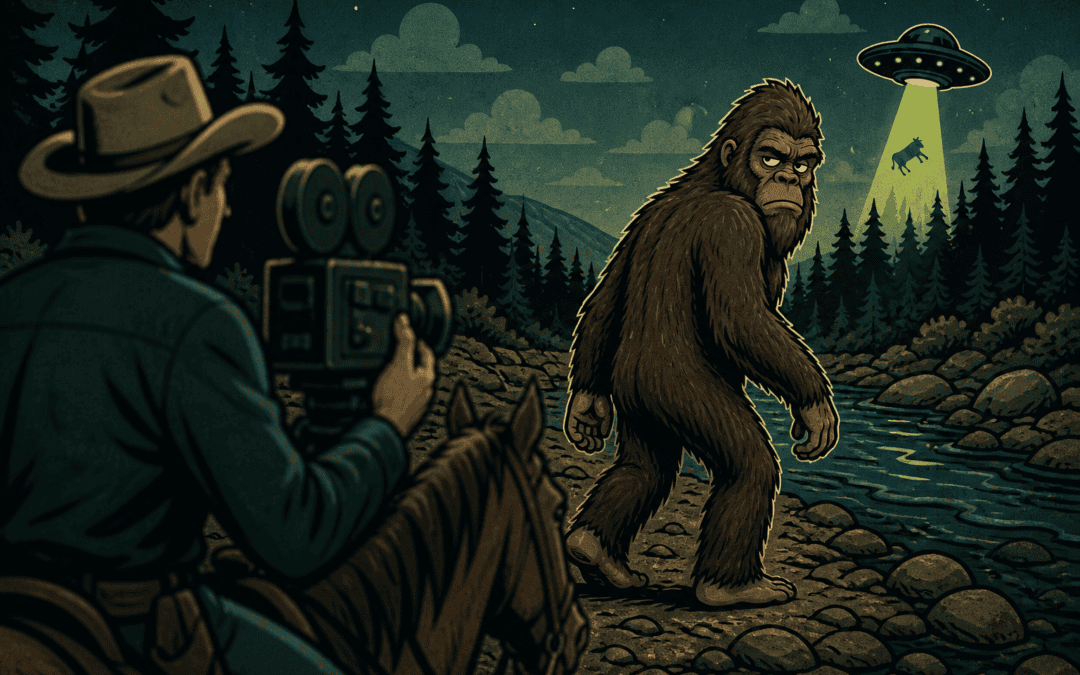
On October 20, 1967, two men on horseback rode into Bluff Creek, California, with a rented 16mm camera and a plan to find Bigfoot. This is, on its face, an insane sentence. It’s the plot of a movie nobody would greenlight — two guys, some horses, a camera, and the stated goal of filming a mythical forest creature on purpose. And yet, against every reasonable expectation, they came home with 59.5 seconds of footage that fifty-seven years, thousands of hours of analysis, and an entire cottage industry of debunkers still haven’t fully killed. Whatever you believe walked across that creek bed, you have to respect the film’s staying power. Nothing else in the history of cryptozoology has come close.
Let’s actually look at what happened, what’s in the footage, and why — despite every reason to dismiss it — the Patterson-Gimlin Film (PGF) refuses to die.
Who Were These Guys, Actually?
Roger Patterson was not a scientist. He was a rodeo rider turned amateur Bigfoot enthusiast who’d already written a self-published book on the subject and had been trying, for years, to get financial backing to go film a Sasquatch documentary. Nobody would fund him — which, frankly, tracks. Bob Gimlin was his friend, an experienced horseman who came along mostly to help manage the horses and, by his own later accounts, was skeptical the whole trip that they’d find anything at all.
This matters because it undercuts one of the tidier “gotcha” narratives people like to apply to the case — that this was some grand hoax cooked up by a mastermind. Patterson was, by every account, a hustler and a showman who was deeply in debt and had every financial incentive to produce something sensational. That’s a real point against the film’s credibility, and we’re not going to pretend otherwise. But “guy who wanted this to be real and profitable” and “guy sophisticated enough to pull off the greatest special-effects hoax of the 1960s with a rented camera and no money” are two very different profiles, and there’s a real tension between them that’s never been fully resolved.
What’s Actually in the Footage
Here’s what happens, stripped of hype: Patterson and Gimlin are riding along Bluff Creek when their horses spook. Patterson dismounts, grabs the camera, and starts running toward the creek bed while filming — which is why the first several seconds are a shaky, blurred mess (see our earlier field guide on why panic-filming ruins good evidence; Patterson is patient zero for this problem). Once he steadies the shot, we see a large, dark, hair-covered bipedal figure walking away from the camera along the creek bank. At one point, the figure turns its head and looks back toward the camera before continuing on and disappearing into the treeline.
That’s it. That’s the whole encounter. Under a minute of an upright figure walking away from a shaky camera. And yet this single minute of film has been frame-analyzed more thoroughly than the Zapruder film, cited in academic papers, argued over by primatologists, and is still, to this day, the single most recognizable piece of cryptid evidence on Earth. If you close your eyes and picture “Bigfoot,” you are picturing this footage, whether you’ve seen it or not. That’s the actual, measurable cultural power of 59.5 seconds of shaky 16mm film — and it’s worth taking seriously as a phenomenon even if you take the creature itself with a heavy dose of salt.
The Case Against It (The Honest Version)
We promised real skepticism, so here it is, not the strawman version.
The “man in a suit” problem. The most persistent claim is that the figure is a person wearing a costume, and there’s a specific name attached to it: Bob Heironimus, a Bluff Creek local who claimed in the 1990s that Patterson paid him to wear a gorilla suit for the filming. This claim has real weight — Heironimus passed a polygraph test about it, and costume designer Philip Morris has claimed he sold Patterson a suit around that time. Against that: no photograph of the actual suit in question has ever surfaced, and multiple analyses of the film show musculature movement and proportions that were extremely difficult to replicate with 1967-era costume technology (arm length relative to leg length is one of the most commonly cited oddities — the figure’s arms are proportionally longer than a human’s, in a way that’s hard to fake with a suit built on a human frame).
The financial motive. Patterson needed money and had already tried to sell a Bigfoot narrative before this footage existed. That’s a legitimately damning coincidence. People with strong financial incentives to produce something extraordinary should always be viewed with extra scrutiny, no exceptions, no matter how much we enjoy the story.
The chain of custody is a mess. The original film has changed hands multiple times, been copied and recopied, and the “original” negative’s whereabouts have been disputed for decades. Every re-examination is working from degraded, generation-loss copies, which makes definitive frame analysis harder than it should be for something this famous.
The Case For It (Also the Honest Version)
The gait analysis. This is the part that actually keeps researchers up at night. Multiple biomechanics analyses — including some by people with no dog in the cryptid fight, just an interest in human/primate locomotion — have noted that the figure’s walking gait, particularly a visible compliant gait (a bent-knee walking style that shifts the whole body’s center of mass in a specific way) is unusual and difficult to consciously fake. A person told to “walk like Bigfoot” tends to exaggerate movement in ways that don’t match what’s on film. This doesn’t prove a cryptid; it just means “guy in a suit doing a normal human walk” doesn’t fully explain what’s visible either.
No costume like it existed in 1967. This is the point skeptics have to actually grapple with, not wave away. Studio-quality creature suits with visible muscle definition, correct proportions, and a texture-matched pelt were not a solved problem in 1967 — that technology, in any real form, is closer to a 1980s and beyond development. Something built by an amateur, on essentially no budget, in rural California, that has held up under fifty-plus years of professional-grade frame analysis, would be an achievement in its own right, hoax or not.
It’s never been definitively debunked. This is the line that matters most and gets lost in casual conversation about the film. Despite five decades of motivated, well-funded, expert attempts to conclusively prove this is a man in a suit, nobody has produced the suit, the actual seams, the actual zipper, a matching prototype — anything physical that closes the case. Claims exist. Confessions exist. Proof does not.
So What Do We Actually Think?
Here’s our honest position, because “it’s definitely real” and “it’s definitely fake” are both cop-outs that let you stop thinking about it. We think this is the single best piece of evidence cryptozoology has ever produced, and we think “best evidence” and “actually proof of an undiscovered species” are two very different bars to clear. The Patterson-Gimlin Film cleared the first bar in 1967 and hasn’t been dethroned since — no drone footage, no trail cam photo, no thermal imaging clip from the last five decades of exponentially better camera technology has come remotely close to matching its cultural or evidentiary weight. If Bigfoot is real, this is still the best look anyone’s ever gotten. If it’s a hoax, it’s the best-executed hoax in the history of amateur film, made by two guys with a horse, a rented camera, and apparently more patience for detail than anyone’s given them credit for.
Either way — 57 years later, we’re still talking about it, which is more than you can say for almost anything else filmed in 1967.
Next up: we head to New Mexico, 1947, for the crash that the government swears was just a weather balloon. It was not just a weather balloon.
by chris | Aug 2, 2026 | Bigfoot
Filed under: Case Files | Cryptid Cynic
So you saw something. Big, hairy, upright, gone before you could get your phone out of airplane mode. First of all — congratulations. You’ve joined a club that includes thousands of hunters, hikers, truckers, and at least one guy who swears it happened while he was “just getting ice from the cooler.” Second of all — you’re about to make every mistake that turns a genuinely interesting encounter into forty seconds of comment-section roasting. Let’s fix that.
Step 1: Stop Filming Your Own Screaming
I’ve watched more Bigfoot footage than is medically advisable, and I can tell you the single biggest tell of a fake — or just a badly documented real encounter — is that the camera operator is having a full nervous breakdown while filming. Nine seconds of “OH MY GOD OH MY GOD DO YOU SEE THAT” pointed at a tree, one second of the actual subject, then more screaming. If you see something, the instinct is to react like a human. The trick is to react like a nature documentarian who’s already dead inside. Breathe. Widen the shot. Let it walk. Screaming doesn’t add credibility — it just adds volume.
Step 2: Get Something in the Frame for Scale
This is the actual, useful, educational part, so pay attention. The reason 90% of cryptid photos are useless isn’t that they’re blurry — cameras have been good enough since roughly 2007. It’s that there’s nothing in the frame to compare size against. A blob against an empty field could be six feet tall or sixteen. If there’s a fence post, a car, your buddy Gary standing there in shock — get it in frame. Scale is the difference between “compelling” and “that’s a bear, Gary.”
Step 3: Understand That Your Brain Is Lying to You (Probably)
This is the part that’ll actually make you smarter about this stuff, and it’s not a cop-out — it’s genuinely how memory works. Under stress, the brain doesn’t record video, it records fragments and then fills in gaps later with expectation. This is well-documented in eyewitness testimony research (ask any defense attorney how much they trust a rattled witness). If you already believe Bigfoot exists, your brain is more likely to interpret “dark shape, upright, gone in two seconds” as Bigfoot rather than “black bear standing to sniff the air,” which is a real thing bears do constantly and is misidentified as Sasquatch more than almost anything else. Being skeptical of your own experience isn’t an insult to it — it’s the only way to make it credible.
Step 4: Note the Boring Details, Not the Exciting Ones
Everybody remembers “IT LOOKED RIGHT AT ME.” Nobody remembers wind direction, time of day, ground moisture, or whether there were other footprints, tracks, or disturbed brush nearby. The boring stuff is what separates an actual data point from a campfire story. Researchers (the credible ones, not the ones with a merch table) care about substrate — was the ground soft enough to hold a print? Was there anything else moving in the area that could explain it? If you want to be taken seriously, be the annoying person who writes down the mundane details instead of just the scary ones.
Step 5: Do Not, Under Any Circumstances, Immediately Post to Reddit
I know. I know it’s tempting. You saw something incredible and you want validation right now. Don’t. Reddit cryptid communities are basically the DMV of paranormal discourse — endless queue, nobody in charge, everyone assumes you’re lying before you’ve finished your sentence. Write it down first. Get your details straight while they’re fresh, before the comment section rewrites your memory for you with “it was probably your neighbor in a ghillie suit, checkmate.” Document first, get roasted later — the order matters.
The Actually Useful Takeaway
None of this is about “proving” anything — I’m still deeply skeptical that a seven-foot bipedal primate has evaded discovery in North America for a century while every possum in my yard gets caught on a $40 trail cam. But the process of documenting a strange experience well is genuinely useful, whether what you saw was a legendary cryptid or a bear standing up to check what stinks near the garbage cans. Slow down, get scale, distrust your own adrenaline, write down the boring parts, and for the love of god stop screaming at the camera.
You probably didn’t see Bigfoot. But if you did — do better than everyone before you.
Got a sighting story you actually documented properly? Send it in — we might feature it. Got one where you screamed the whole time? Also send it in, we need the content.