by chris | Aug 12, 2026 | Crypid
Filed under: Case Files | Cryptid Cynic
Every region needs a designated “weird stuff happens here” explanation, and New Jersey’s Pine Barrens got theirs earlier and more thoroughly than almost anywhere else in America. The Jersey Devil — a creature description so specific and so bizarre that it’s genuinely hard to compare to any other entry on this site — has been the go-to explanation for over 260 years of odd noises, strange tracks, and things going missing in a 1.1-million-acre pine forest that, even today, remains one of the most sparsely populated and genuinely eerie wilderness areas on the entire East Coast.
The Origin Legend
The most commonly told version dates the creature’s birth to 1735, and it’s worth telling in full because it’s genuinely one of the strangest founding myths of any cryptid, period. According to the legend, a woman named Mother Leeds (sometimes given the first name Deborah), already exhausted from raising twelve children in the Pine Barrens, discovered she was pregnant with a thirteenth and reportedly cursed the child during a difficult labor, supposedly crying out that the baby could “be the devil” for all she cared. The child was allegedly born looking normal, then transformed almost immediately — growing hooves, wings, a horse-like or goat-like head, and a forked tail — before killing the midwife and flying up the chimney to disappear into the Pine Barrens, where it’s supposedly lived and terrorized the region ever since.
We want to be completely clear about something before going further: there’s no contemporary 1735 documentation of this event actually happening. This origin story is folklore in the truest sense — an oral tradition that was written down and popularized much later, almost certainly evolving and getting embellished across generations before anyone put it on paper. Some historians have also proposed a more grounded, considerably less supernatural theory for where the story actually came from: a real historical figure, Daniel Leeds, was a colonial-era almanac publisher whose work included astrological symbols and content that devout Quaker neighbors in the area found genuinely offensive and borderline heretical for the time. Leeds became locally unpopular enough that some historians suspect the “Leeds Devil” legend may have originated, at least partly, as folk mockery or genuine local suspicion directed at the Leeds family specifically, later merging with the more elaborate supernatural birth-curse narrative as it spread. If true, this would make the Jersey Devil one of the rare cryptids with a plausible origin rooted in actual small-town interpersonal drama rather than a monster sighting at all — which is, frankly, a very New Jersey way for a legend to start.
The Physical Description, and Why It’s So Specific
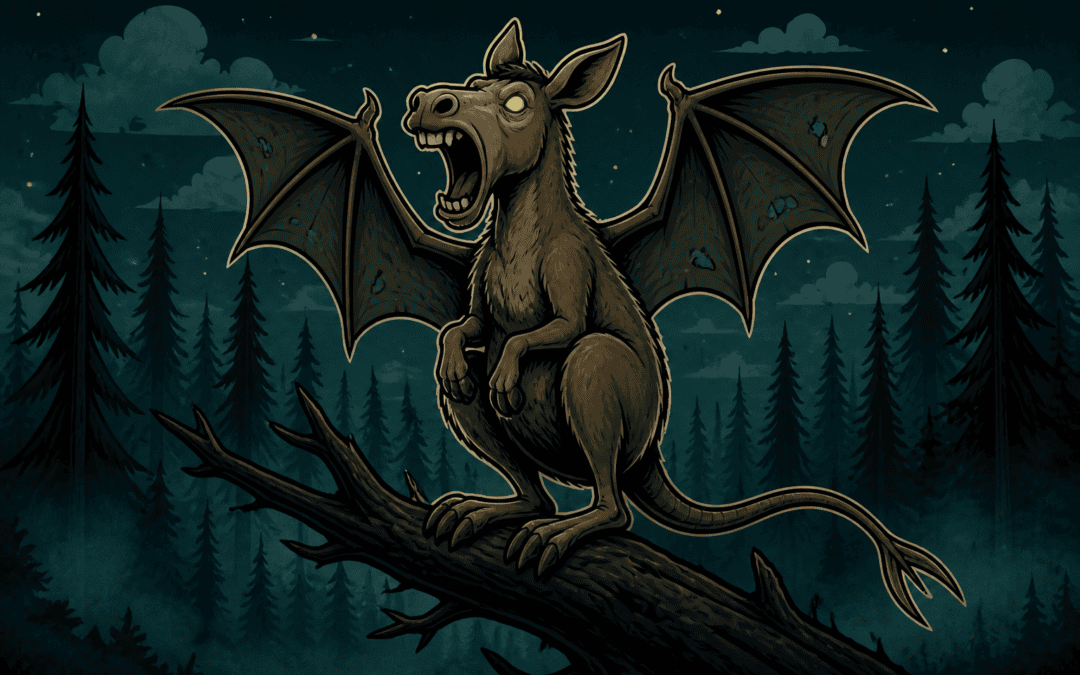
Unlike Bigfoot or most lake monsters, where descriptions vary fairly widely between witnesses, the Jersey Devil’s description has stayed remarkably consistent across nearly three centuries: a creature roughly the size of a large dog or small kangaroo, standing or hopping bipedally, with leathery bat-like wings, a horse- or goat-like elongated head, cloven hooves, small clawed forelimbs, and a long, thin, forked tail. It’s frequently described as making a distinctive, high-pitched shrieking or screaming sound before or during a sighting. That level of cross-witness consistency over multiple centuries is genuinely unusual in this genre — it suggests either a remarkably stable, deeply embedded regional folklore template that gets applied consistently to ambiguous sightings (the far more likely explanation), or, if you’re inclined to be generous to the believers, a genuinely consistent unknown species with a stable, recognizable physical profile passed down through repeated real encounters. We lean heavily toward the former, but the consistency itself is worth acknowledging as a genuinely interesting feature of the case.
The 1909 Sighting Panic — The Actual Historical Peak of This Story
If the 1735 birth story is folklore, the January 1909 “Jersey Devil sighting week” is very much real, documented history, and it’s the actual reason this legend has the staying power it does. Over roughly a week, newspapers across the greater Philadelphia and South Jersey region reported an extraordinary wave of sightings and strange track discoveries — hundreds of claimed encounters across multiple towns, some from credible sources including police officers and postmasters, describing a creature matching the traditional description. Schools in several towns closed due to widespread public fear. Posses were organized to hunt the creature. A reward was reportedly offered by a Philadelphia entertainment promoter for its capture (a detail that should immediately raise your skepticism, given how directly it incentivized false claims and copycat reports for financial gain).
This week of intense, well-documented regional panic is genuinely one of the best-recorded mass cryptid events in American history — comparable in scale and documentation quality to the Flatwoods and Mothman cases we’ve covered, but happening decades earlier and getting far less modern attention, which is exactly the gap we’re trying to fill with this piece. Contemporary newspaper accounts, strange tracks found in snow across multiple towns, and a genuine, verifiable week of public terror are all real historical facts, independent of what actually caused them.
The Skeptical Case
Given the timing — deep winter, snow on the ground, a promoter openly offering money for a captured specimen — the 1909 panic has several very plausible mundane drivers that deserve serious weight. Media contagion is an obvious and well-supported factor: once the story ran in one paper, competing papers across the region had commercial incentive to report their own local sightings, real or embellished, and that kind of newspaper-driven copycat reporting cycle is well documented in other historical panics of the era, unrelated to any cryptid. Misidentified wildlife tracks in snow — particularly from kangaroos, several of which had genuinely escaped from a private menagerie and traveling circus in the region around this general period, a detail cryptid researchers frequently cite — could plausibly explain both the described bipedal hopping gait and the otherwise unusual track patterns reported in multiple towns. And a cash reward openly offered for the creature’s capture is about as clean an incentive for hoaxed sightings and fabricated tracks as this genre ever produces.
What We Actually Think
We think the Jersey Devil is best understood less as a single creature-identification mystery and more as a genuinely fascinating case study in how folklore, regional identity, and media incentives compound over centuries to build something that outlives any single explanation. The 1735 origin is almost certainly folklore, possibly rooted in real small-town grudges against an unpopular colonial publisher. The 1909 panic is real, well-documented history, almost certainly amplified by newspaper competition and a genuinely bad-incentive cash reward, on top of a plausible misidentified-wildlife baseline (hello again, escaped kangaroos).
But 260-plus years is a long time for a story to survive purely on newspaper competition and colonial grudges, and the Pine Barrens themselves — genuinely remote, genuinely strange, one of the largest under-populated forest tracts left on the entire Eastern Seaboard — have never stopped producing the occasional strange sighting report, right up to the present day. We don’t think there’s a leathery-winged, cloven-hoofed creature living in the Pine Barrens. We do think New Jersey deserves more credit for having, quietly, one of the oldest, weirdest, and most historically well-documented cryptid legends in the entire country, and getting a fraction of the pop-culture attention Mothman or Bigfoot get for it.
by chris | Aug 10, 2026 | Crypid
Filed under: Case Files | Cryptid Cynic
Every cryptid on this site has a moment where the modern legend actually began, separate from any older folklore that might have existed before it. For Nessie, that moment is remarkably precise: 1933, when a new road was built along the northern shore of Loch Ness, suddenly giving drivers a clear, unobstructed view of the water for the first time in the loch’s history. Sightings exploded almost immediately afterward. That’s not a coincidence anyone tries very hard to hide — it’s on the record, in the actual local newspapers of the era. And yet, ninety-plus years, one of the most famous photographic hoaxes in history, multiple sonar expeditions, and a full-blown environmental DNA study later, we’re still talking about this lake like it might be hiding something. Let’s find out why.
The Older Legend, Briefly
Before we get to 1933, it’s worth noting Loch Ness folklore didn’t spring from nothing — a 6th-century biography of Saint Columba describes him supposedly banishing a “water beast” from the River Ness in 565 AD. This gets cited constantly as evidence of an ancient, unbroken tradition, but it deserves real skepticism on its own terms: medieval saints’ biographies are absolutely stuffed with miraculous beast-banishing stories as a standard hagiographic device, used to demonstrate a saint’s holiness, not as literal wildlife reporting. Treating a 6th-century religious text as a credible eyewitness cryptid sighting is a stretch that even most Nessie believers don’t lean on heavily anymore, and we won’t either.
The real modern legend starts with that 1933 road.
The Photo That Built an Industry
In 1934, a London surgeon named Robert Kenneth Wilson published a photograph showing what appeared to be a long, curved neck and small head rising from the water — the image that, more than any other single artifact, defined what “the Loch Ness Monster” is supposed to look like in the public imagination. The “Surgeon’s Photograph” ran in newspapers worldwide and became the template silhouette for the entire legend.
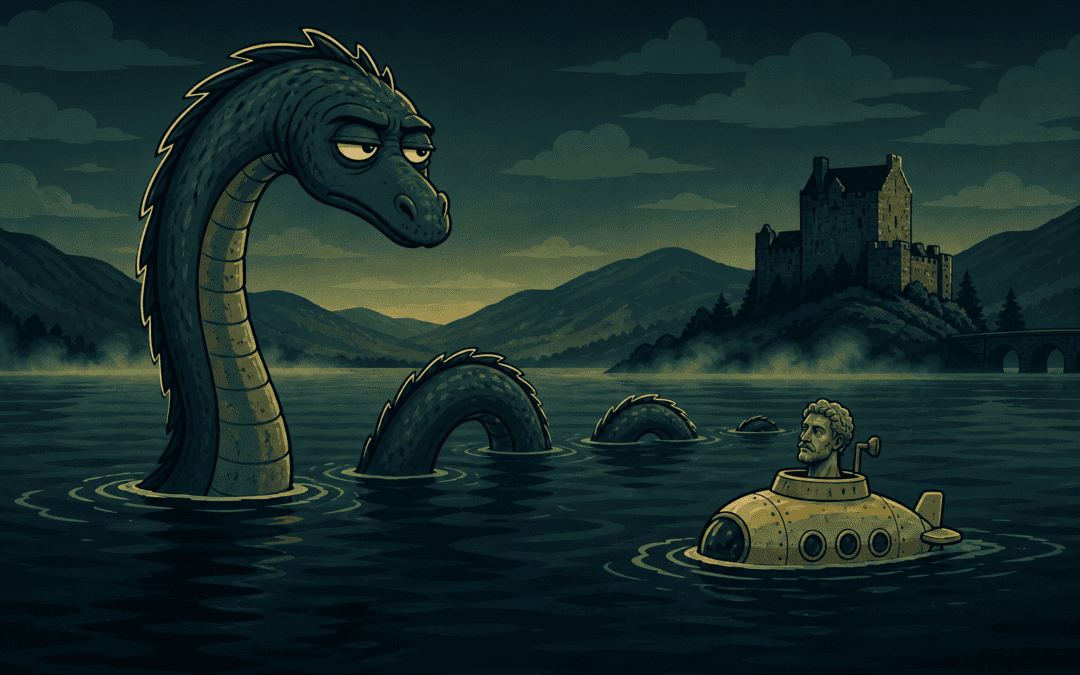
In 1994, decades after the fact, it was definitively revealed as a hoax — a small sculpted head and neck mounted on a toy submarine, built by a man named Christian Spurling, at the instigation of a group that included Marmaduke Wetherell, a big-game hunter who had been publicly humiliated earlier that year after “monster tracks” he’d found and reported turned out to be made with a hippo-foot ashtray stand. The whole thing was reportedly staged as revenge against the newspaper that had mocked him. This is, genuinely, one of the greatest details in all of cryptid history: the most famous monster photograph on Earth exists because a guy got embarrassed by a hippo-foot ashtray and wanted to save face.
We’re leading with this not to dunk on Nessie believers, but because it’s important context for everything that follows: the legend’s most iconic single image is a confirmed, admitted fraud, built out of petty revenge, not mistaken identity or genuine belief. That’s a different category of “debunked” than most cryptid photos get, and it’s worth being upfront about it.
So Why Didn’t the Legend Die With the Photo?
This is the actually interesting part. A legend built on a confirmed hoax photograph should, by all reasonable logic, have collapsed the moment that hoax came to light. It didn’t, because — and this is true of Nessie more than almost any other cryptid on this site — the 1934 photo was never the only evidence people were working from. Sightings had already been rolling in for a full year before Wilson’s photo existed, from ordinary residents with no financial stake in the story, and they kept rolling in for decades after the hoax was exposed, largely unaffected by the revelation. That’s a meaningfully different pattern than a legend that depends entirely on one faked artifact — the fraud discredited a specific piece of media, not the underlying phenomenon of “people keep seeing something in this lake.”
The Sonar Era: 1950s Through Today
Loch Ness has been hit with more serious scientific instrumentation than arguably any other cryptid location on Earth, and that’s genuinely to its credit as a research subject, whatever you conclude from the results.
Robert Rines, an MIT-trained patent attorney and inventor, ran multiple sonar and underwater photography expeditions starting in the 1970s, and one 1972 sonar/photography combination produced an image that Rines and his team interpreted as showing a large, diamond-shaped flipper. It’s genuinely one of the more serious pieces of Nessie evidence ever produced, backed by real instrumentation and a credentialed researcher rather than a random tourist snapshot — and it’s also been criticized extensively for image enhancement techniques of the era that some analysts argue introduced artifacts that weren’t in the raw data, essentially “finding” a flipper shape in enhanced noise. The debate over this specific image has never fully settled either way, which is a genuinely unsatisfying but accurate summary.
Operation Deepscan in 1987 deployed a coordinated flotilla of boats with sonar equipment sweeping the entire loch simultaneously — one of the most serious, well-funded search efforts ever mounted for any cryptid, anywhere. It picked up a few unexplained sonar contacts at depth, but nothing conclusive, and no follow-up visual or physical evidence was ever obtained to clarify what those contacts were. “A few weird sonar blips, no confirmation” isn’t nothing, but it’s a far cry from proof, and researchers involved have been candid about that gap ever since.
The eDNA Study: The Most Scientifically Rigorous Attempt Yet
This is the one that deserves the most attention and gets the least mainstream coverage, and it’s genuinely fascinating regardless of which side of this debate you’re on. In 2018-2019, a team led by geneticist Neil Gemmell conducted a comprehensive environmental DNA survey of Loch Ness — taking water samples throughout the loch and sequencing the genetic material shed by every organism living in or passing through the water, a technique with real, validated scientific applications well beyond cryptid research (it’s used seriously in conservation biology to survey species presence without physical capture).
The results, published in 2019, found no genetic evidence of any large, unknown species, plesiosaur-like reptile, or unclassified organism in the loch. What the study did find, in genuinely large quantities, was eel DNA — a huge amount of it, present throughout the loch at every depth sampled. Gemmell himself, notably, didn’t dismiss the phenomenon outright; he specifically raised the possibility that an unusually large eel, or a population of eels reaching greater size than typically documented, could account for at least some sighting reports, given how much eel genetic material was present relative to other species. This is actually a satisfying, scientifically grounded partial answer that gets underreported compared to the flashier “Nessie is fake” headline the study generated — the honest conclusion is closer to “no unknown giant reptile, but also an unexpectedly large amount of unaccounted-for eel biomass in a loch people have been reporting a serpentine creature in for ninety years,” which is a genuinely interesting, if less thrilling, place to land.
The Boring (But Real) Explanations for Most Individual Sightings
Loch Ness has a specific set of well-documented mundane phenomena that account for a large share of reported sightings, and they’re worth knowing because they show up in the vast majority of photographic “Nessie” claims when examined closely. Standing waves and seiches — a kind of internal water oscillation caused by wind and the loch’s unusual depth and shape — can produce moving humps and wakes on the surface with no animal involved at all. Floating logs, waterlogged and partially submerged, are extremely common in the loch due to the surrounding pine forests, and a partially sunk log riding just below the surface produces a shape and wake pattern that matches a huge number of reported sightings almost exactly. And boat wakes, particularly from the loch’s active tourist boat traffic, can create long, low, serpentine-looking wave patterns that are frequently misidentified when viewed from a distance or at an odd angle, especially by someone already primed by the loch’s reputation to interpret ambiguous shapes generously.
What We Actually Think
We think the honest, current scientific position is this: there is no large unknown species living in Loch Ness, and the most rigorous, most modern piece of evidence — a genuinely serious genetic survey of the entire loch — found nothing to support one. What we do think is genuinely interesting, and gets buried under the “Nessie debunked” headlines, is that the eDNA study didn’t produce a fully boring answer either: it left real, unresolved questions about eel biomass and size in the loch that nobody had good data on before, and those questions are worth someone following up on for their own sake, independent of monster hunting.
Ninety years in, the most famous monster photo in history is a confirmed fraud born out of a grudge over a hippo ashtray, and the most sophisticated genetic survey ever conducted on the loch found no cryptid — just an unexpected abundance of a fish nobody was thinking about. That’s not the ending anyone wanted when this story started. But it might be the most honest one this genre has produced yet.
Next up: we head to the Pine Barrens of New Jersey, where a 260-year-old legend has been blamed for basically everything strange that’s ever happened in that forest.
by chris | Aug 8, 2026 | Crypid
Filed under: Case Files | Cryptid Cynic
West Virginia has, by any reasonable accounting, punched wildly above its weight in the cryptid department. We’ve already covered Mothman, the state’s marquee export, terrifier of Point Pleasant, star of its own movie. But nine years before Mothman ever showed up, a small town called Flatwoods produced its own encounter — arguably stranger, considerably better-witnessed at the time, and somehow almost nobody outside serious cryptid circles has ever heard of it. That’s a genuine oversight, and we’re here to fix it.
September 12, 1952: A Very Bad Night to Be Curious
The story starts, as so many of these do, with kids and a light in the sky. A group of boys playing football in Flatwoods, a small town in Braxton County, saw what they described as a bright object streak across the sky and appear to land on a nearby hilltop property owned by a local farmer, Bailey Fisher. This alone isn’t unusual — bright meteors get misreported as “landing” nearby constantly, an important detail we’ll return to. What makes this case different is what happened next: the boys ran home, and instead of the story dying there, they recruited more witnesses.
The group that headed up the hill to investigate wasn’t a couple of overexcited kids — it eventually included Kathleen May (a local woman and mother of two of the boys), a 17-year-old National Guardsman named Eugene Lemon, several other neighborhood children, and Lemon’s dog, which reportedly ran ahead of the group and began barking wildly before promptly running back, distressed enough that it stands out as a genuine data point in an era before anyone was trying to embellish animal reactions for internet clout.
What They Actually Reported
At the top of the hill, in fog and near a foul, metallic-smelling mist that multiple witnesses independently described as making their eyes and throats burn (a detail worth sitting with — that’s a specific, consistent physical sensation reported across multiple people, not just a visual claim), the group’s flashlights reportedly illuminated a tall figure near the tree line. Descriptions varied slightly across witnesses, as they always do, but the core account was remarkably consistent: a towering figure, estimated at seven to ten feet tall, with a dark or metallic-looking body, and a distinctive spade-shaped or hood-like head with two glowing eye-like openings. Some witnesses described the lower portion of the figure as appearing to float or hover rather than showing visible legs, folded like drapery or a skirt-like base.
Lemon reportedly screamed and the group fled the hillside immediately. Several members of the group, including May and some of the children, later reported physical symptoms in the following hours and days — nausea, vomiting, and throat irritation, severe enough that a local doctor examined multiple witnesses and, per contemporary reports, attributed the symptoms to a form of nervous hysteria brought on by fright rather than any external toxin, though this diagnosis has been revisited skeptically many times since, for reasons we’ll get into.
The National Guardsman Detail Actually Matters
It’s worth pausing on something easy to skim past: one of the primary witnesses wasn’t a child prone to imaginative storytelling, but a 17-year-old enlisted National Guardsman, a demographic not typically associated with fabricating monster encounters for attention, especially in a small, socially conservative 1952 Appalachian town where that kind of story could plausibly damage your reputation rather than build a following. That doesn’t make the account true. But it’s a meaningfully different credibility profile than “anonymous internet post,” and deserves more weight than it usually gets in casual retellings.
The Skeptical Case (Given Its Full Due)
Let’s do our job properly, because this case has a genuinely strong mundane explanation on the table, and pretending otherwise would be dishonest.
The night of September 12, 1952 coincided with a real, documented meteor event — bright fireballs were reported across multiple states that evening, giving a very plausible mundane origin for the “object landing on the hill” portion of the story. A bright meteor, especially one that appeared to terminate near the observer’s horizon due to perspective, is a well-documented source of “something landed over there” reports, even though meteors that appear to land nearby are almost always burning up at high altitude, many miles away, with no actual physical touchdown anywhere near the observer.
The “monster” sighting itself has a genuinely compelling competing explanation, and it’s more specific and satisfying than most skeptical takes in this genre: researcher Joe Nickell proposed in the early 2000s that the entire figure could be explained by a barn owl, perched on a branch at height in fog and darkness, with its face illuminated from below by the witnesses’ own flashlights — owl faces, lit from underneath in exactly this way, can appear strikingly humanoid, with the classic heart-shaped facial disc resembling a “hood,” and the eyes producing the reported glow through the same eyeshine phenomenon we covered in our Mothman piece (a barn owl doesn’t have eyeshine quite like a nocturnal mammal, but the flashlight-and-fog combination has been demonstrated to produce a very similar disorienting effect in reconstructed conditions). The apparent height estimate, exaggerated under fright and poor visibility, and the “floating” lower body, potentially explained by fog obscuring where legs or a branch actually met the ground, round out a genuinely coherent alternative explanation that doesn’t require dismissing any single witness as lying.
The burning eyes and throat irritation are also explainable without anything exotic: some researchers have proposed the group may have wandered into a patch of ground vegetation or a natural gas seep common to the region, or simply experienced a documented physiological stress response, hyperventilation and panic bringing on nausea and throat tightness independent of any external chemical cause. None of these require coordination between witnesses or bad faith from anyone involved — just fear, fog, poor lighting, and a startled group of people encountering an unfamiliar bird at the worst possible moment.
Why This Case Deserves More Attention, Regardless of What It Was
Here’s the actual point of this piece, and it’s less about “was it real” and more about “why doesn’t anyone talk about this one.” The Flatwoods case has genuinely unusual features that separate it from the average cryptid report: a same-night astronomical event that’s independently verifiable through historical records, multiple witnesses with real, checkable identities (not anonymous forum posts), consistent physical symptom reports across separate individuals, and a specific, well-reasoned mundane explanation (the owl-in-fog theory) that’s more detailed and testable than “eh, probably a bear” — the lazy default explanation applied to half the cases in this genre.
That combination — strong witness credibility, a real astronomical anchor event, physical symptoms worth taking seriously, and a genuinely thoughtful skeptical counter-theory — is more than most far more famous cases can claim. Mothman gets the movie. Roswell gets the merchandise. Flatwoods gets… occasionally mentioned in passing on cryptid podcasts, and that’s about it. We think that’s a genuine miscarriage of cryptid-content justice, and we’re doing our small part to correct it.
What We Actually Think
We think the barn-owl-in-fog theory is a strong, well-reasoned explanation and probably the closest thing to a real answer this case has — Joe Nickell did his homework, and “startled group encounters unfamiliar large bird under terrible visibility conditions right after a genuinely frightening meteor event” checks nearly every box the evidence presents. But we also think “well-reasoned mundane explanation” and “case fully closed” aren’t the same thing, especially given how specific and consistent the physical symptom reports were across multiple independent people, which the owl theory explains less cleanly than it explains the visual sighting itself.
Either way: this is a genuinely interesting, under-covered piece of American cryptid history, and if you’re only aware of West Virginia’s paranormal reputation through Mothman, you’re missing half the story. Flatwoods deserves its own footnote in the culture, at minimum. Consider this our attempt to give it one.
by chris | Aug 8, 2026 | Field Gear
Filed under: Field Guides | Cryptid Cynic
Trail cameras solve the single biggest credibility problem in cryptid research, and it’s not a subtle one: every human eyewitness account is filtered through adrenaline, expectation, and imperfect memory the second something startling happens. A trail camera doesn’t get scared. It doesn’t embellish. It doesn’t remember the encounter as slightly bigger and slightly closer every time it retells the story at a bar. It just sits there, unmanned, and records whatever walks past at 3 AM — which is exactly the kind of boring, unglamorous, high-integrity evidence this field desperately needs more of.
Here’s what actually matters when picking one, and five real options across budget tiers.
What Actually Matters
Trigger speed. This is the single most important spec and the one beginners ignore. Trigger speed is how long it takes the camera to actually start recording after its motion sensor detects movement. A camera with a 1-second trigger speed will consistently miss fast-moving animals entirely — you’ll get a picture of an empty trail seconds after whatever it was has already passed through frame. Anything under 0.5 seconds is the real baseline for usable wildlife documentation; under 0.3 seconds is genuinely good.
Detection range and angle. A wider detection cone means fewer blind spots, but also more false triggers from waving branches and passing insects. This is a real tradeoff, not a “bigger number always wins” spec — a narrower, well-aimed detection zone pointed at an actual game trail will out-perform a wide-angle camera pointed at open brushy field.
No-glow vs. low-glow infrared. Standard infrared night-vision cameras emit a faint red glow visible to animals (and to any curious hoaxer who might want to know exactly where your camera is, worth considering if you’re on private land). True no-glow (black flash) cameras are invisible even at night, at some cost to night image clarity. If your goal is genuinely unbiased documentation — not tipping off whatever might be nearby that it’s on camera — no-glow is worth the premium.
Battery life and storage. Anything you’re leaving in the woods for weeks needs real battery efficiency and SD card capacity, since your entire dataset is worthless if the batteries die on week two of a month-long deployment.
The List
1. Browning Strike Force Pro — Best All-Around Sub-0.4-second trigger speed, solid detection range, and genuinely good night image quality for the price point. This is the trail camera most serious wildlife researchers actually recommend as a baseline, not because it’s flashy, but because it consistently delivers on the fundamentals: fast trigger, clear image, reliable battery life. If you buy one camera off this list, this is the one to start with.
2. Reconyx HyperFire 2 — Best for Serious Documentation This is the professional-grade option, used by actual wildlife biologists for peer-reviewed field studies, which tells you everything about its reliability. Trigger speed under 0.2 seconds, exceptional battery life (some models rated for a full year on a single set of batteries), and image quality that holds up to genuine scrutiny. It’s a real investment, but if your goal is building a body of documentation you’d actually stand behind, this is the camera that removes “the equipment was inadequate” as a possible objection to your findings.
3. Moultrie Delta Base — Best Budget Option A genuinely solid entry-level camera for someone who wants to try this out without a major investment. Trigger speed and detection range are noticeably behind the two above, and night image clarity is a step down, but it’s a real, usable camera rather than a toy, and a fine way to get your first month of backyard or property data before deciding whether to upgrade.
4. Bushnell Core DS No-Glow — Best for Discretion True no-glow infrared, dual-sensor technology for better exposure balance between foreground and background, and a genuinely stealthy physical profile. If you’re deploying on a property where you don’t want the camera’s presence obvious — either to wildlife or to two-legged visitors — this is the pick.
5. GPS-Tagged Cellular Trail Cameras (various brands) — Best for Remote Monitoring A newer category worth mentioning: cellular-enabled trail cams that send photos directly to your phone in real time instead of requiring a physical SD card retrieval trip. These come with a data plan cost, and image quality is often a small step down from top-tier standalone cameras due to compression for transmission, but the ability to get a same-day alert instead of finding out three weeks later that something interesting walked by is a genuinely different research workflow, especially for locations you can’t easily revisit often.
The Actually Important Setup Advice
Buying a good camera solves half the problem. Placement solves the other half, and it’s the half most beginners skip. Point cameras along established game trails, not open clearings — animals, real or theoretical, follow paths of least resistance through brush just like humans do. Set the camera at the height of the torso of your target subject, not eye-level for a human, since most trail cams are mis-mounted at a height suited to photographing deer, not a seven-foot hypothetical bipedal primate. And — this is the boring, unglamorous, absolutely critical step everyone skips — let the camera run for at least two to four weeks before drawing any conclusions from what it does or doesn’t capture. A single night of nothing tells you nothing. A month of consistent, documented nothing is actually useful data.
The Actual Takeaway
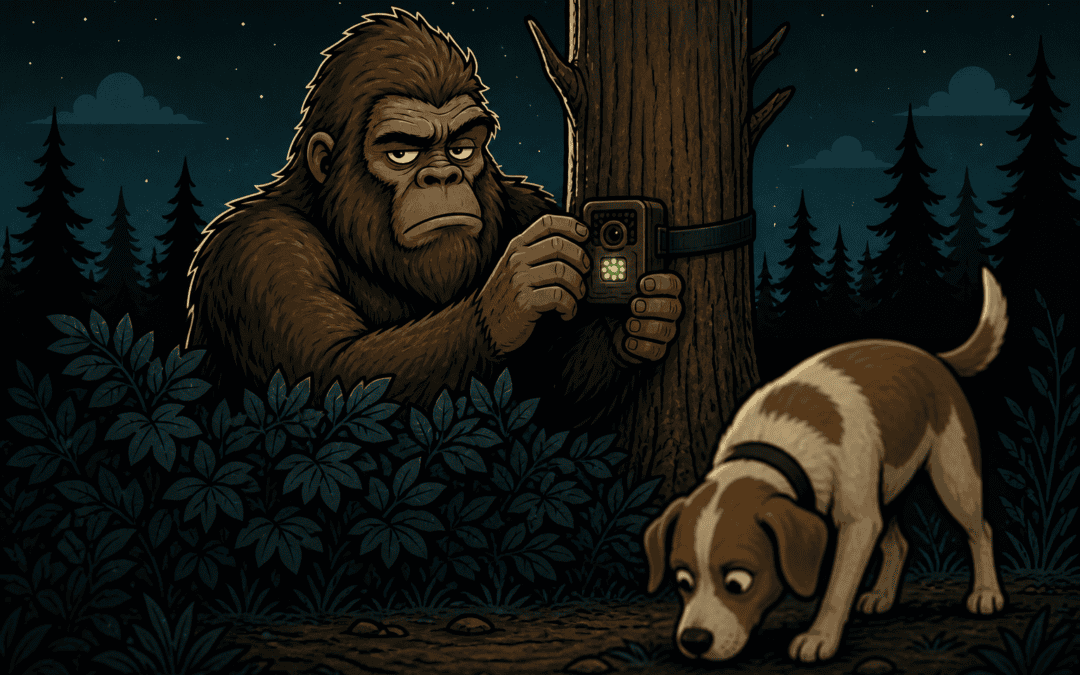
A trail camera won’t settle the Bigfoot question, obviously — if it were that simple, millions of hunters running these cameras across North America for the last two decades would have settled it by now, and that absence of definitive footage is itself a real, if imperfect, data point worth sitting with. But a good trail camera setup, run patiently and documented honestly, is about as close as an amateur researcher gets to actual scientific rigor in this hobby. Buy the best one your budget allows, aim it at a real game trail, and give it time. Worst case, you get great photos of your neighbor’s dog. Best case, you get something nobody can wave away as a shaky, panicked, adrenaline-blurred human account.
Next up: the Flatwoods Monster — West Virginia’s other, weirder, criminally underrated cryptid that nobody talks about.
by chris | Aug 8, 2026 | Bigfoot
Filed under: Rankings & Lists | Cryptid Cynic
We’ve covered Patterson-Gimlin in depth already, and it’s rightfully the most famous entry in the Bigfoot canon. But it’s far from the only sighting with staying power, and not all “famous Bigfoot encounters” are created equal. Some hold up shockingly well under scrutiny. Some fall apart the second you apply even mild critical thinking. A few are so transparently silly it’s a wonder they’re still repeated at all.
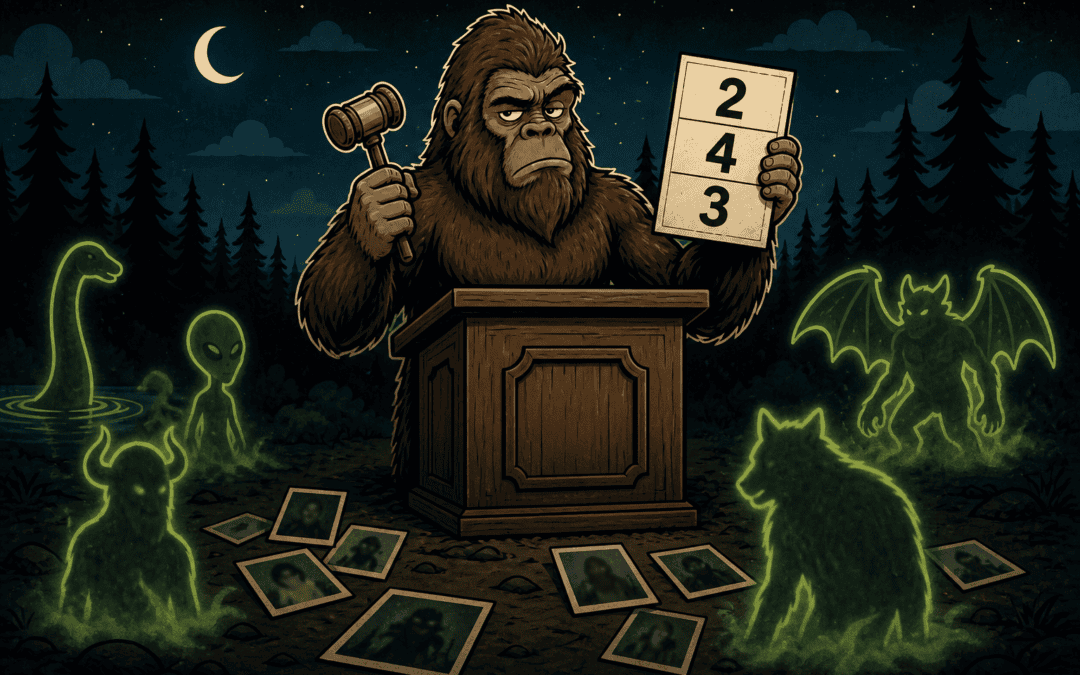
So let’s do what nobody in this genre wants to do: rank them, honestly, from “actually kind of compelling” to “please stop citing this one.” No sacred cows. Patterson-Gimlin gets a mention too, just for context, even though it’s already got its own dedicated case file.
10. The Georgia Costume Hoax (2008) — Plausibility: 0/10
We’re starting at the bottom because this one deserves to be remembered as a cautionary tale, not a mystery. In 2008, two men named Rick Dyer and Matthew Whitton claimed to have found a Bigfoot corpse in the Georgia woods, froze it, and presented it to media with enormous fanfare, including a paid press conference. When the “body” thawed on camera, it turned out to be a rubber costume stuffed into a freezer, with fake teeth and hollow feet. This isn’t a “the evidence didn’t hold up” story — this is a deliberate, admitted hoax, later confirmed by the hoaxers themselves. We include it purely so you can recognize its DNA in other, sneakier claims. If a story involves a body, a press conference, and merchandise timing, run.
9. The Skookum Cast (2000) — Plausibility: 2/10
Researchers with the Bigfoot Field Researchers Organization found an impression in mud in Washington state that they claimed showed a large creature’s body, hip, arm, and heel print where it had allegedly lain down. It got serious media coverage at the time. The problem: primatologists and forensic analysts who examined casts of the impression identified features far more consistent with an elk bedding down in mud — hoof marks, characteristic elk body positioning, and none of the anatomical consistency you’d expect from an actual limb impression. This one gets a slightly higher score than the Georgia hoax only because it wasn’t a deliberate fraud — just a case of enthusiastic pattern-matching overriding careful analysis.
8. The Jacobs Photograph / “Freeman Footage” Cases — Plausibility: 2/10
A recurring category rather than a single case: various photographs and short videos, often from named individual researchers, showing a distant dark shape in brush that the photographer insists is Bigfoot. These almost universally suffer from the same fatal flaw we hammered in our field-guide post: no scale reference, no follow-up documentation, no corroborating tracks, and often a single source with a financial or reputational interest in the outcome. Individually forgettable; collectively, they make up the bulk of “evidence” you’ll find if you go looking, which says more about the genre’s evidentiary standards than about the creature itself.
7. The Myakka Skunk Ape Photos (2000) — Plausibility: 4/10
An anonymous woman in Florida mailed two photographs to a local sheriff’s department showing a large, hairy, ape-like creature crouched near a fence, allegedly photographed in her backyard after it raided her dog food. Unlike most cases on this list, there’s an interesting evidentiary wrinkle: the photos have actual clarity, an identifiable background, and a plausible mundane motive (dog food, seriously) rather than a dramatic forest encounter. Against it: the photographer never came forward publicly, was never independently interviewed on record, and no follow-up evidence (tracks, further sightings, additional photos) ever materialized. Interesting, underexamined, ultimately inconclusive — the “skunk ape” regional variant of Bigfoot lore deserves its own case file at some point, honestly.
6. The Bossburg Cripple-Foot Tracks (1969) — Plausibility: 5/10
A set of footprints found near Bossburg, Washington, showing a consistent, distinctive deformed right foot across dozens of individual prints over a long trackway. This one is genuinely interesting from a hoax-difficulty standpoint: faking one deformed footprint is trivial. Faking dozens of prints, in a long consistent trackway, with a consistent individualized deformity, weight distribution, and natural-looking stride variation across uneven terrain, is a considerably higher bar for a hoaxer to clear convincingly, especially with 1969 tools. Anthropologist Grover Krantz took this case seriously specifically because of the difficulty-to-fake argument. Skeptics counter that a sufficiently dedicated hoaxer with a custom-carved wooden foot stamp could still produce this, and no one has ever produced the physical foot-stamp in question to end the debate either way.
5. The Onion Mountain / Trail-Camera “Hand” Photos — Plausibility: 5/10
A category rather than one case: multiple modern trail-camera photos allegedly showing a large hand or partial limb reaching toward the camera or nearby foliage. These get a genuinely middling score because trail cameras solve one of the biggest historical credibility problems (they’re unmanned, so there’s no panicked human operator, and timestamps are automatic and harder to fake than a claimed date). Against them: the low-light, motion-triggered nature of trail cams also makes misidentification of a bear paw, a low branch, or lens artifacts from infrared flash genuinely common, and verified chain-of-custody on these photos is often weak — they tend to circulate without clear sourcing.
4. Multiple, Independent, Same-Week Sightings Clusters — Plausibility: 6/10
Not a single case, but a recurring pattern worth its own entry: incidents where multiple unconnected witnesses, in the same general area, within a short window, independently report similar sightings without apparent contact or coordination with each other beforehand. These cluster events (several documented in the Pacific Northwest over the decades) are statistically more interesting than any single report, because they reduce (though don’t eliminate) the “one guy’s imagination” explanation. They don’t rule out a shared mundane cause — misidentified wildlife under similar seasonal conditions can produce genuine clusters too — but independent corroboration within a tight timeframe is a real, meaningful step up in evidentiary weight over any isolated account.
3. The Patterson-Gimlin Film (1967) — Plausibility: 7/10
We’ve given this one a full case file already, so we won’t relitigate it in depth here — but for ranking purposes, it earns its high placement for reasons we laid out at length: the gait analysis, the era-inappropriate costume complexity required to fake it, and the fact that fifty-plus years of dedicated, well-funded skeptical effort has never produced the actual suit. It remains the single best piece of evidence the field has ever produced, which is a real, measurable claim, not just nostalgia.
2. The Sierra Sounds Recordings (1970s) — Plausibility: 7/10
Ron Morehead and Al Berry recorded hours of vocalizations in the Sierra Nevada mountains that they attributed to Bigfoot, and here’s the detail that keeps this case alive in serious circles: linguists and acoustic analysts who’ve examined the recordings, including some without any prior belief in the subject, have noted the vocalizations show structured, language-like qualities — formant patterns and vocal tract characteristics that are difficult to attribute to any known human or animal source using period recording equipment. This is genuinely harder to fake convincingly than a visual hoax, because replicating structured formant patterns requires either an unknown source or a very sophisticated audio hoax that nobody has ever stepped forward to claim credit for. Against it: audio evidence is inherently harder to verify than visual evidence, chain of custody on 1970s tape recordings is imperfect by modern standards, and “linguists find it interesting” isn’t the same as “linguists confirm non-human origin.”
1. The Consistency of Independent Physical Descriptions Across Uncorrelated Cultures and Eras — Plausibility: 8/10
This isn’t a single sighting, and that’s exactly why it ranks highest. Across wildly different time periods, cultures, and geographic regions — Pacific Northwest tribal oral traditions predating European contact, Himalayan Yeti accounts, Australian Yowie reports, and modern North American sightings — there’s a genuinely striking consistency in core physical description: large, bipedal, ape-like, covered in hair, avoidant of humans, nocturnal or crepuscular in behavior. Cross-cultural consistency, absent modern media contamination (which is a real confound for anything post-1970s, to be fair), is one of the more scientifically interesting arguments in the whole field, because independent invention of the same specific creature profile across unconnected cultures is a harder coincidence to wave away than any single blurry photo. It’s not proof. But it’s the entry on this list that actually made us pause the longest while writing it.
The Actual Takeaway
Ranking these side by side makes something clear that gets lost when each case is covered in isolation: this field’s evidentiary quality is wildly inconsistent, ranging from “deliberate rubber-suit fraud” to “linguists genuinely can’t fully explain the audio.” That range is exactly why blanket dismissal and blanket belief are both intellectually lazy responses to the subject. The right approach is what we keep coming back to on this site: take each case on its own individual merits, weigh it honestly, and stay comfortable saying “this one’s actually pretty interesting” and “this one’s nonsense” in the same breath, sometimes about cases from the same decade.
Next up: we put the rankings down and get practical again — the trail cameras actually worth buying if you want a shot at catching something on camera, cryptid or otherwise.