
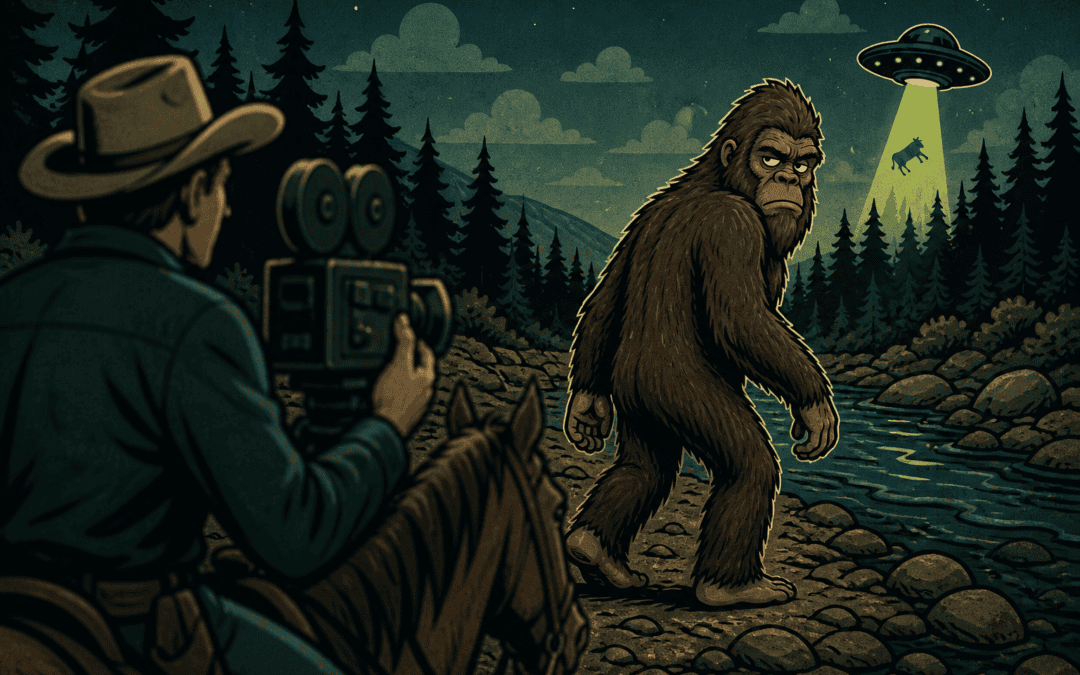
The Patterson-Gimlin Film: 57 Years Later and Still the Best Home Video Ever Shot
Filed under: Case Files | Cryptid Cynic
On October 20, 1967, two men on horseback rode into Bluff Creek, California, with a rented 16mm camera and a plan to find Bigfoot. This is, on its face, an insane sentence. It’s the plot of a movie nobody would greenlight — two guys, some horses, a camera, and the stated goal of filming a mythical forest creature on purpose. And yet, against every reasonable expectation, they came home with 59.5 seconds of footage that fifty-seven years, thousands of hours of analysis, and an entire cottage industry of debunkers still haven’t fully killed. Whatever you believe walked across that creek bed, you have to respect the film’s staying power. Nothing else in the history of cryptozoology has come close.
Let’s actually look at what happened, what’s in the footage, and why — despite every reason to dismiss it — the Patterson-Gimlin Film (PGF) refuses to die.
Who Were These Guys, Actually?
Roger Patterson was not a scientist. He was a rodeo rider turned amateur Bigfoot enthusiast who’d already written a self-published book on the subject and had been trying, for years, to get financial backing to go film a Sasquatch documentary. Nobody would fund him — which, frankly, tracks. Bob Gimlin was his friend, an experienced horseman who came along mostly to help manage the horses and, by his own later accounts, was skeptical the whole trip that they’d find anything at all.
This matters because it undercuts one of the tidier “gotcha” narratives people like to apply to the case — that this was some grand hoax cooked up by a mastermind. Patterson was, by every account, a hustler and a showman who was deeply in debt and had every financial incentive to produce something sensational. That’s a real point against the film’s credibility, and we’re not going to pretend otherwise. But “guy who wanted this to be real and profitable” and “guy sophisticated enough to pull off the greatest special-effects hoax of the 1960s with a rented camera and no money” are two very different profiles, and there’s a real tension between them that’s never been fully resolved.
What’s Actually in the Footage
Here’s what happens, stripped of hype: Patterson and Gimlin are riding along Bluff Creek when their horses spook. Patterson dismounts, grabs the camera, and starts running toward the creek bed while filming — which is why the first several seconds are a shaky, blurred mess (see our earlier field guide on why panic-filming ruins good evidence; Patterson is patient zero for this problem). Once he steadies the shot, we see a large, dark, hair-covered bipedal figure walking away from the camera along the creek bank. At one point, the figure turns its head and looks back toward the camera before continuing on and disappearing into the treeline.
That’s it. That’s the whole encounter. Under a minute of an upright figure walking away from a shaky camera. And yet this single minute of film has been frame-analyzed more thoroughly than the Zapruder film, cited in academic papers, argued over by primatologists, and is still, to this day, the single most recognizable piece of cryptid evidence on Earth. If you close your eyes and picture “Bigfoot,” you are picturing this footage, whether you’ve seen it or not. That’s the actual, measurable cultural power of 59.5 seconds of shaky 16mm film — and it’s worth taking seriously as a phenomenon even if you take the creature itself with a heavy dose of salt.
The Case Against It (The Honest Version)
We promised real skepticism, so here it is, not the strawman version.
The “man in a suit” problem. The most persistent claim is that the figure is a person wearing a costume, and there’s a specific name attached to it: Bob Heironimus, a Bluff Creek local who claimed in the 1990s that Patterson paid him to wear a gorilla suit for the filming. This claim has real weight — Heironimus passed a polygraph test about it, and costume designer Philip Morris has claimed he sold Patterson a suit around that time. Against that: no photograph of the actual suit in question has ever surfaced, and multiple analyses of the film show musculature movement and proportions that were extremely difficult to replicate with 1967-era costume technology (arm length relative to leg length is one of the most commonly cited oddities — the figure’s arms are proportionally longer than a human’s, in a way that’s hard to fake with a suit built on a human frame).
The financial motive. Patterson needed money and had already tried to sell a Bigfoot narrative before this footage existed. That’s a legitimately damning coincidence. People with strong financial incentives to produce something extraordinary should always be viewed with extra scrutiny, no exceptions, no matter how much we enjoy the story.
The chain of custody is a mess. The original film has changed hands multiple times, been copied and recopied, and the “original” negative’s whereabouts have been disputed for decades. Every re-examination is working from degraded, generation-loss copies, which makes definitive frame analysis harder than it should be for something this famous.
The Case For It (Also the Honest Version)
The gait analysis. This is the part that actually keeps researchers up at night. Multiple biomechanics analyses — including some by people with no dog in the cryptid fight, just an interest in human/primate locomotion — have noted that the figure’s walking gait, particularly a visible compliant gait (a bent-knee walking style that shifts the whole body’s center of mass in a specific way) is unusual and difficult to consciously fake. A person told to “walk like Bigfoot” tends to exaggerate movement in ways that don’t match what’s on film. This doesn’t prove a cryptid; it just means “guy in a suit doing a normal human walk” doesn’t fully explain what’s visible either.
No costume like it existed in 1967. This is the point skeptics have to actually grapple with, not wave away. Studio-quality creature suits with visible muscle definition, correct proportions, and a texture-matched pelt were not a solved problem in 1967 — that technology, in any real form, is closer to a 1980s and beyond development. Something built by an amateur, on essentially no budget, in rural California, that has held up under fifty-plus years of professional-grade frame analysis, would be an achievement in its own right, hoax or not.
It’s never been definitively debunked. This is the line that matters most and gets lost in casual conversation about the film. Despite five decades of motivated, well-funded, expert attempts to conclusively prove this is a man in a suit, nobody has produced the suit, the actual seams, the actual zipper, a matching prototype — anything physical that closes the case. Claims exist. Confessions exist. Proof does not.
So What Do We Actually Think?
Here’s our honest position, because “it’s definitely real” and “it’s definitely fake” are both cop-outs that let you stop thinking about it. We think this is the single best piece of evidence cryptozoology has ever produced, and we think “best evidence” and “actually proof of an undiscovered species” are two very different bars to clear. The Patterson-Gimlin Film cleared the first bar in 1967 and hasn’t been dethroned since — no drone footage, no trail cam photo, no thermal imaging clip from the last five decades of exponentially better camera technology has come remotely close to matching its cultural or evidentiary weight. If Bigfoot is real, this is still the best look anyone’s ever gotten. If it’s a hoax, it’s the best-executed hoax in the history of amateur film, made by two guys with a horse, a rented camera, and apparently more patience for detail than anyone’s given them credit for.
Either way — 57 years later, we’re still talking about it, which is more than you can say for almost anything else filmed in 1967.
Next up: we head to New Mexico, 1947, for the crash that the government swears was just a weather balloon. It was not just a weather balloon.