
Filed under: Cryptids of Maine | Cryptid Cynic
If you want to understand why Maine’s folklore hits differently than the rest of the country’s, you have to understand who was actually telling these stories first. Long before trail cameras and Reddit threads, Maine’s North Woods were full of logging camps — isolated, dangerous, boring in exactly the ways that breed elaborate campfire mythology. Loggers spent entire winters cut off from towns, doing genuinely dangerous work, with nothing to fill the silence but each other’s stories. The Tote Road Shagamaw is one of the best products of that specific culture, and it deserves to be far better known outside Maine than it currently is.
What It’s Supposed to Be
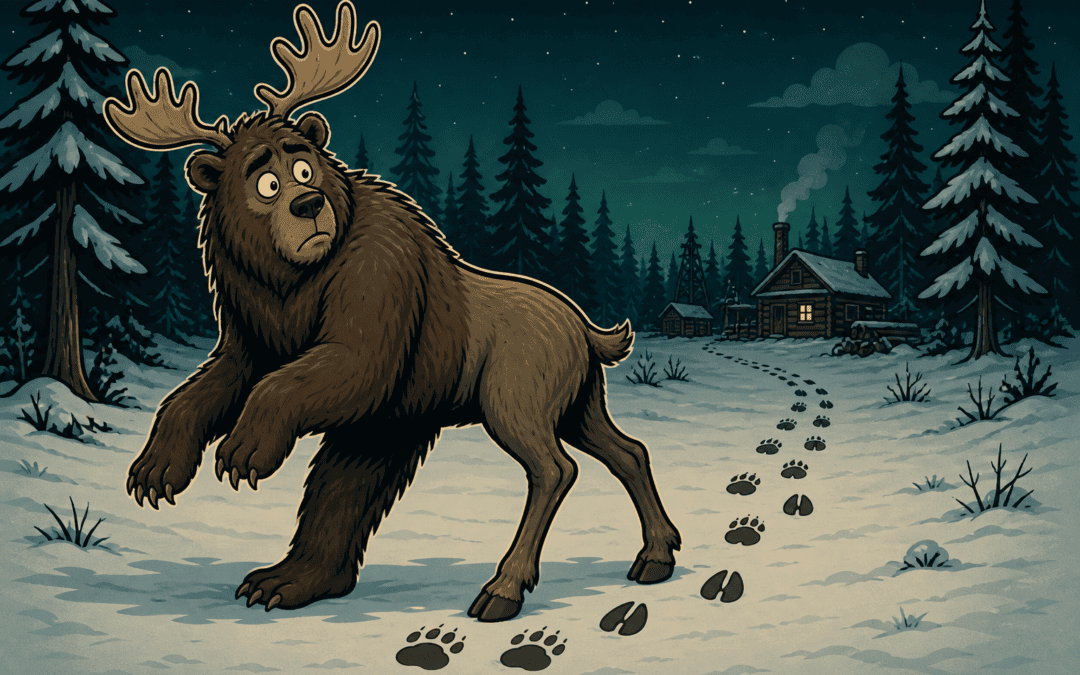
The Shagamaw is described as a half-bear, half-moose creature — a genuinely strange chimera even by cryptid standards, most of which stick to a single animal template exaggerated in size. Accounts describe a heavyset, shaggy body with bear-like features up top and a moose-like lower half, complete with hoof-like feet. But the detail that actually makes this legend memorable, and the reason it survived generations of logging camps passing it down, is its gait: the Shagamaw is said to walk on its front legs (bear-style) for a stretch, then switch to walking upright on its hind legs (moose-style) for another stretch, alternating back and forth as it moves through the woods. This produces, according to the legend, a genuinely bizarre track pattern — bear-like prints for a while, then moose-like prints, then back again, in the same trail, from the same animal.
That detail is the entire engine of the legend, and it’s worth appreciating as a piece of pure logging-camp craftsmanship: an ordinary hunter or trapper stumbling across a confusing, mixed-up animal track in the snow — plausible if multiple different animals crossed paths at different times, or if snowmelt distorted a single animal’s prints unevenly — needs an explanation. The Shagamaw is that explanation, retrofitted onto a mundane, common tracking-confusion problem and turned into an entire creature.
Where It Fits in the “Fearsome Critters” Tradition
The Shagamaw isn’t a standalone legend — it’s part of a much larger, genuinely fascinating body of North American logging folklore known as “fearsome critters,” a term used by folklorists to describe an entire invented bestiary that lumberjacks across the northern U.S. and Canada developed throughout the 19th and early 20th centuries. These weren’t campfire ghost stories meant to terrify — they were often functional, half-comedic explanations for real hazards and oddities of camp life, frequently used to haze newcomers or explain away unexplained camp mishaps (“something got into the food stores” becomes a much better story with a named creature attached to it).
This context matters, because it changes how you should read the Shagamaw compared to something like Mothman or the Jersey Devil. Nobody in a 1920s Maine logging camp was reporting a Shagamaw sighting to a sheriff, terrified for their life. This was shared folklore, told with a wink, functioning more like an inside joke passed between workers than a genuine paranormal claim — closer to a tall tale than a cryptid sighting in the modern sense. That doesn’t make it less worth covering. It makes it a genuinely different, underappreciated category of “weird stuff people believed,” one built by working people to entertain and explain their own dangerous, isolating jobs, rather than one built by media panic or a single dramatic encounter.
The Skeptical (and Slightly Redundant) Case
We’d be overstating things to spend much time “debunking” the Shagamaw, given that it was likely never meant to be taken as literally as, say, Bigfoot. The mixed bear/moose track theory holds up fine as an explanation for the legend’s origin — overlapping or distorted animal tracks in snow are a real, common source of confusion for anyone who isn’t an expert tracker, and Maine’s North Woods have plenty of both bears and moose sharing the same trails. The “walks on four legs, then two” detail is almost certainly embellishment added for storytelling color, since no known animal actually alternates gaits that dramatically.
What We Actually Think
We think the Shagamaw deserves a place in Maine’s cryptid canon not because anyone should search for one, but because it’s a genuinely great example of folklore functioning exactly the way folklore is supposed to: turning a real, mundane confusion (mixed-up animal tracks) into a shared, entertaining regional story that outlived the working culture that invented it by nearly a century. If Bigfoot is a mystery people want to solve, the Shagamaw is a story people were always in on — which, honestly, might be the more honest relationship to have with a monster.