
Filed under: Case Files | Cryptid Cynic
Every region needs a designated “weird stuff happens here” explanation, and New Jersey’s Pine Barrens got theirs earlier and more thoroughly than almost anywhere else in America. The Jersey Devil — a creature description so specific and so bizarre that it’s genuinely hard to compare to any other entry on this site — has been the go-to explanation for over 260 years of odd noises, strange tracks, and things going missing in a 1.1-million-acre pine forest that, even today, remains one of the most sparsely populated and genuinely eerie wilderness areas on the entire East Coast.
The Origin Legend
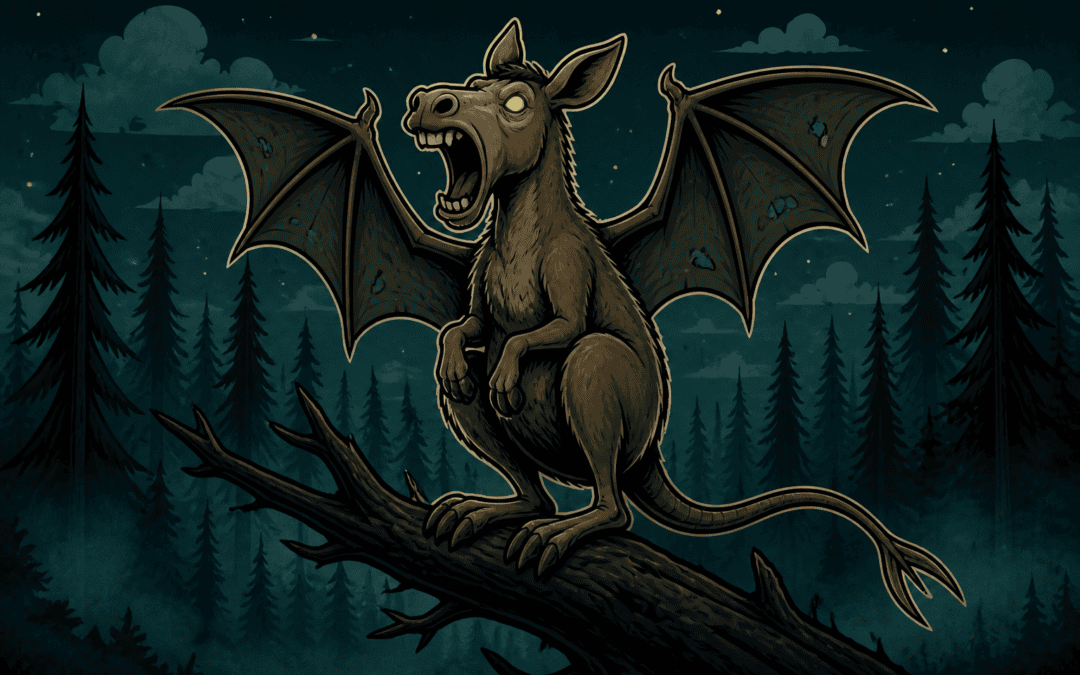
The most commonly told version dates the creature’s birth to 1735, and it’s worth telling in full because it’s genuinely one of the strangest founding myths of any cryptid, period. According to the legend, a woman named Mother Leeds (sometimes given the first name Deborah), already exhausted from raising twelve children in the Pine Barrens, discovered she was pregnant with a thirteenth and reportedly cursed the child during a difficult labor, supposedly crying out that the baby could “be the devil” for all she cared. The child was allegedly born looking normal, then transformed almost immediately — growing hooves, wings, a horse-like or goat-like head, and a forked tail — before killing the midwife and flying up the chimney to disappear into the Pine Barrens, where it’s supposedly lived and terrorized the region ever since.
We want to be completely clear about something before going further: there’s no contemporary 1735 documentation of this event actually happening. This origin story is folklore in the truest sense — an oral tradition that was written down and popularized much later, almost certainly evolving and getting embellished across generations before anyone put it on paper. Some historians have also proposed a more grounded, considerably less supernatural theory for where the story actually came from: a real historical figure, Daniel Leeds, was a colonial-era almanac publisher whose work included astrological symbols and content that devout Quaker neighbors in the area found genuinely offensive and borderline heretical for the time. Leeds became locally unpopular enough that some historians suspect the “Leeds Devil” legend may have originated, at least partly, as folk mockery or genuine local suspicion directed at the Leeds family specifically, later merging with the more elaborate supernatural birth-curse narrative as it spread. If true, this would make the Jersey Devil one of the rare cryptids with a plausible origin rooted in actual small-town interpersonal drama rather than a monster sighting at all — which is, frankly, a very New Jersey way for a legend to start.
The Physical Description, and Why It’s So Specific
Unlike Bigfoot or most lake monsters, where descriptions vary fairly widely between witnesses, the Jersey Devil’s description has stayed remarkably consistent across nearly three centuries: a creature roughly the size of a large dog or small kangaroo, standing or hopping bipedally, with leathery bat-like wings, a horse- or goat-like elongated head, cloven hooves, small clawed forelimbs, and a long, thin, forked tail. It’s frequently described as making a distinctive, high-pitched shrieking or screaming sound before or during a sighting. That level of cross-witness consistency over multiple centuries is genuinely unusual in this genre — it suggests either a remarkably stable, deeply embedded regional folklore template that gets applied consistently to ambiguous sightings (the far more likely explanation), or, if you’re inclined to be generous to the believers, a genuinely consistent unknown species with a stable, recognizable physical profile passed down through repeated real encounters. We lean heavily toward the former, but the consistency itself is worth acknowledging as a genuinely interesting feature of the case.
The 1909 Sighting Panic — The Actual Historical Peak of This Story
If the 1735 birth story is folklore, the January 1909 “Jersey Devil sighting week” is very much real, documented history, and it’s the actual reason this legend has the staying power it does. Over roughly a week, newspapers across the greater Philadelphia and South Jersey region reported an extraordinary wave of sightings and strange track discoveries — hundreds of claimed encounters across multiple towns, some from credible sources including police officers and postmasters, describing a creature matching the traditional description. Schools in several towns closed due to widespread public fear. Posses were organized to hunt the creature. A reward was reportedly offered by a Philadelphia entertainment promoter for its capture (a detail that should immediately raise your skepticism, given how directly it incentivized false claims and copycat reports for financial gain).
This week of intense, well-documented regional panic is genuinely one of the best-recorded mass cryptid events in American history — comparable in scale and documentation quality to the Flatwoods and Mothman cases we’ve covered, but happening decades earlier and getting far less modern attention, which is exactly the gap we’re trying to fill with this piece. Contemporary newspaper accounts, strange tracks found in snow across multiple towns, and a genuine, verifiable week of public terror are all real historical facts, independent of what actually caused them.
The Skeptical Case
Given the timing — deep winter, snow on the ground, a promoter openly offering money for a captured specimen — the 1909 panic has several very plausible mundane drivers that deserve serious weight. Media contagion is an obvious and well-supported factor: once the story ran in one paper, competing papers across the region had commercial incentive to report their own local sightings, real or embellished, and that kind of newspaper-driven copycat reporting cycle is well documented in other historical panics of the era, unrelated to any cryptid. Misidentified wildlife tracks in snow — particularly from kangaroos, several of which had genuinely escaped from a private menagerie and traveling circus in the region around this general period, a detail cryptid researchers frequently cite — could plausibly explain both the described bipedal hopping gait and the otherwise unusual track patterns reported in multiple towns. And a cash reward openly offered for the creature’s capture is about as clean an incentive for hoaxed sightings and fabricated tracks as this genre ever produces.
What We Actually Think
We think the Jersey Devil is best understood less as a single creature-identification mystery and more as a genuinely fascinating case study in how folklore, regional identity, and media incentives compound over centuries to build something that outlives any single explanation. The 1735 origin is almost certainly folklore, possibly rooted in real small-town grudges against an unpopular colonial publisher. The 1909 panic is real, well-documented history, almost certainly amplified by newspaper competition and a genuinely bad-incentive cash reward, on top of a plausible misidentified-wildlife baseline (hello again, escaped kangaroos).
But 260-plus years is a long time for a story to survive purely on newspaper competition and colonial grudges, and the Pine Barrens themselves — genuinely remote, genuinely strange, one of the largest under-populated forest tracts left on the entire Eastern Seaboard — have never stopped producing the occasional strange sighting report, right up to the present day. We don’t think there’s a leathery-winged, cloven-hoofed creature living in the Pine Barrens. We do think New Jersey deserves more credit for having, quietly, one of the oldest, weirdest, and most historically well-documented cryptid legends in the entire country, and getting a fraction of the pop-culture attention Mothman or Bigfoot get for it.