
Filed under: Rankings & Lists | Cryptid Cynic
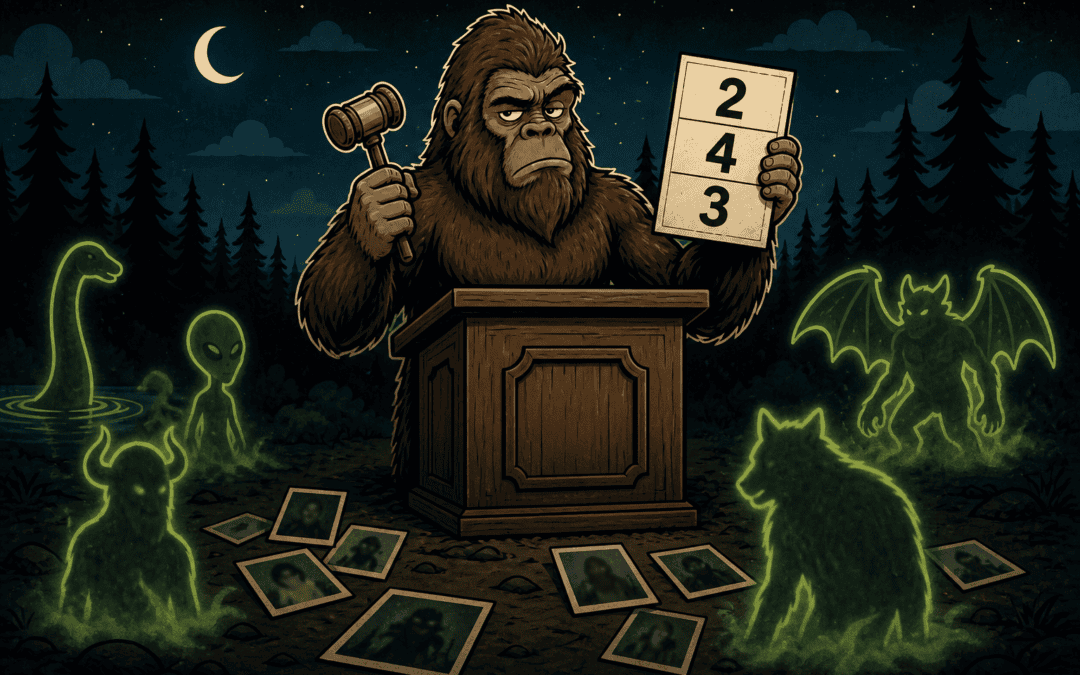
We’ve covered Patterson-Gimlin in depth already, and it’s rightfully the most famous entry in the Bigfoot canon. But it’s far from the only sighting with staying power, and not all “famous Bigfoot encounters” are created equal. Some hold up shockingly well under scrutiny. Some fall apart the second you apply even mild critical thinking. A few are so transparently silly it’s a wonder they’re still repeated at all.
So let’s do what nobody in this genre wants to do: rank them, honestly, from “actually kind of compelling” to “please stop citing this one.” No sacred cows. Patterson-Gimlin gets a mention too, just for context, even though it’s already got its own dedicated case file.
10. The Georgia Costume Hoax (2008) — Plausibility: 0/10
We’re starting at the bottom because this one deserves to be remembered as a cautionary tale, not a mystery. In 2008, two men named Rick Dyer and Matthew Whitton claimed to have found a Bigfoot corpse in the Georgia woods, froze it, and presented it to media with enormous fanfare, including a paid press conference. When the “body” thawed on camera, it turned out to be a rubber costume stuffed into a freezer, with fake teeth and hollow feet. This isn’t a “the evidence didn’t hold up” story — this is a deliberate, admitted hoax, later confirmed by the hoaxers themselves. We include it purely so you can recognize its DNA in other, sneakier claims. If a story involves a body, a press conference, and merchandise timing, run.
9. The Skookum Cast (2000) — Plausibility: 2/10
Researchers with the Bigfoot Field Researchers Organization found an impression in mud in Washington state that they claimed showed a large creature’s body, hip, arm, and heel print where it had allegedly lain down. It got serious media coverage at the time. The problem: primatologists and forensic analysts who examined casts of the impression identified features far more consistent with an elk bedding down in mud — hoof marks, characteristic elk body positioning, and none of the anatomical consistency you’d expect from an actual limb impression. This one gets a slightly higher score than the Georgia hoax only because it wasn’t a deliberate fraud — just a case of enthusiastic pattern-matching overriding careful analysis.
8. The Jacobs Photograph / “Freeman Footage” Cases — Plausibility: 2/10
A recurring category rather than a single case: various photographs and short videos, often from named individual researchers, showing a distant dark shape in brush that the photographer insists is Bigfoot. These almost universally suffer from the same fatal flaw we hammered in our field-guide post: no scale reference, no follow-up documentation, no corroborating tracks, and often a single source with a financial or reputational interest in the outcome. Individually forgettable; collectively, they make up the bulk of “evidence” you’ll find if you go looking, which says more about the genre’s evidentiary standards than about the creature itself.
7. The Myakka Skunk Ape Photos (2000) — Plausibility: 4/10
An anonymous woman in Florida mailed two photographs to a local sheriff’s department showing a large, hairy, ape-like creature crouched near a fence, allegedly photographed in her backyard after it raided her dog food. Unlike most cases on this list, there’s an interesting evidentiary wrinkle: the photos have actual clarity, an identifiable background, and a plausible mundane motive (dog food, seriously) rather than a dramatic forest encounter. Against it: the photographer never came forward publicly, was never independently interviewed on record, and no follow-up evidence (tracks, further sightings, additional photos) ever materialized. Interesting, underexamined, ultimately inconclusive — the “skunk ape” regional variant of Bigfoot lore deserves its own case file at some point, honestly.
6. The Bossburg Cripple-Foot Tracks (1969) — Plausibility: 5/10
A set of footprints found near Bossburg, Washington, showing a consistent, distinctive deformed right foot across dozens of individual prints over a long trackway. This one is genuinely interesting from a hoax-difficulty standpoint: faking one deformed footprint is trivial. Faking dozens of prints, in a long consistent trackway, with a consistent individualized deformity, weight distribution, and natural-looking stride variation across uneven terrain, is a considerably higher bar for a hoaxer to clear convincingly, especially with 1969 tools. Anthropologist Grover Krantz took this case seriously specifically because of the difficulty-to-fake argument. Skeptics counter that a sufficiently dedicated hoaxer with a custom-carved wooden foot stamp could still produce this, and no one has ever produced the physical foot-stamp in question to end the debate either way.
5. The Onion Mountain / Trail-Camera “Hand” Photos — Plausibility: 5/10
A category rather than one case: multiple modern trail-camera photos allegedly showing a large hand or partial limb reaching toward the camera or nearby foliage. These get a genuinely middling score because trail cameras solve one of the biggest historical credibility problems (they’re unmanned, so there’s no panicked human operator, and timestamps are automatic and harder to fake than a claimed date). Against them: the low-light, motion-triggered nature of trail cams also makes misidentification of a bear paw, a low branch, or lens artifacts from infrared flash genuinely common, and verified chain-of-custody on these photos is often weak — they tend to circulate without clear sourcing.
4. Multiple, Independent, Same-Week Sightings Clusters — Plausibility: 6/10
Not a single case, but a recurring pattern worth its own entry: incidents where multiple unconnected witnesses, in the same general area, within a short window, independently report similar sightings without apparent contact or coordination with each other beforehand. These cluster events (several documented in the Pacific Northwest over the decades) are statistically more interesting than any single report, because they reduce (though don’t eliminate) the “one guy’s imagination” explanation. They don’t rule out a shared mundane cause — misidentified wildlife under similar seasonal conditions can produce genuine clusters too — but independent corroboration within a tight timeframe is a real, meaningful step up in evidentiary weight over any isolated account.
3. The Patterson-Gimlin Film (1967) — Plausibility: 7/10
We’ve given this one a full case file already, so we won’t relitigate it in depth here — but for ranking purposes, it earns its high placement for reasons we laid out at length: the gait analysis, the era-inappropriate costume complexity required to fake it, and the fact that fifty-plus years of dedicated, well-funded skeptical effort has never produced the actual suit. It remains the single best piece of evidence the field has ever produced, which is a real, measurable claim, not just nostalgia.
2. The Sierra Sounds Recordings (1970s) — Plausibility: 7/10
Ron Morehead and Al Berry recorded hours of vocalizations in the Sierra Nevada mountains that they attributed to Bigfoot, and here’s the detail that keeps this case alive in serious circles: linguists and acoustic analysts who’ve examined the recordings, including some without any prior belief in the subject, have noted the vocalizations show structured, language-like qualities — formant patterns and vocal tract characteristics that are difficult to attribute to any known human or animal source using period recording equipment. This is genuinely harder to fake convincingly than a visual hoax, because replicating structured formant patterns requires either an unknown source or a very sophisticated audio hoax that nobody has ever stepped forward to claim credit for. Against it: audio evidence is inherently harder to verify than visual evidence, chain of custody on 1970s tape recordings is imperfect by modern standards, and “linguists find it interesting” isn’t the same as “linguists confirm non-human origin.”
1. The Consistency of Independent Physical Descriptions Across Uncorrelated Cultures and Eras — Plausibility: 8/10
This isn’t a single sighting, and that’s exactly why it ranks highest. Across wildly different time periods, cultures, and geographic regions — Pacific Northwest tribal oral traditions predating European contact, Himalayan Yeti accounts, Australian Yowie reports, and modern North American sightings — there’s a genuinely striking consistency in core physical description: large, bipedal, ape-like, covered in hair, avoidant of humans, nocturnal or crepuscular in behavior. Cross-cultural consistency, absent modern media contamination (which is a real confound for anything post-1970s, to be fair), is one of the more scientifically interesting arguments in the whole field, because independent invention of the same specific creature profile across unconnected cultures is a harder coincidence to wave away than any single blurry photo. It’s not proof. But it’s the entry on this list that actually made us pause the longest while writing it.
The Actual Takeaway
Ranking these side by side makes something clear that gets lost when each case is covered in isolation: this field’s evidentiary quality is wildly inconsistent, ranging from “deliberate rubber-suit fraud” to “linguists genuinely can’t fully explain the audio.” That range is exactly why blanket dismissal and blanket belief are both intellectually lazy responses to the subject. The right approach is what we keep coming back to on this site: take each case on its own individual merits, weigh it honestly, and stay comfortable saying “this one’s actually pretty interesting” and “this one’s nonsense” in the same breath, sometimes about cases from the same decade.
Next up: we put the rankings down and get practical again — the trail cameras actually worth buying if you want a shot at catching something on camera, cryptid or otherwise.