
Filed under: Case Files | Cryptid Cynic
Most of the stories on this site involve something that might not be real — a cryptid, a saucer, a moth-shaped omen. Dyatlov Pass is different, and it’s worth sitting with that difference for a second before we go further: nine real people, experienced hikers, died in the Ural Mountains in February 1959, under circumstances that remain, over six decades and multiple official and unofficial investigations later, genuinely unresolved. This isn’t a campfire story. It’s an open case with a body count, and it deserves to be treated with more weight than “spooky mystery content” usually gets.
With that said — let’s dig in, because the actual facts of this case are stranger than almost any fictional horror story could invent, and understanding why is more interesting than any single theory about what caused it.
Who Were They, and What Were They Doing?
In late January 1959, a group of nine experienced Ural Polytechnic Institute students and graduates, led by 23-year-old Igor Dyatlov, set out on a ski trekking expedition through the northern Ural Mountains, aiming for Gora Otorten — a peak whose name, in the local Mansi language, has been informally translated by some as meaning “don’t go there,” a detail every article about this case mentions and that we’re including too, because it’s genuinely eerie even if the translation itself is disputed among linguists.
These were not novices. This was a Category III trek, the most difficult grade in the Soviet hiking classification system at the time, and the group had the certifications and experience to attempt it. One member turned back early due to illness — the only member of the original group of ten who survived, purely because of bad timing that happened to save his life.
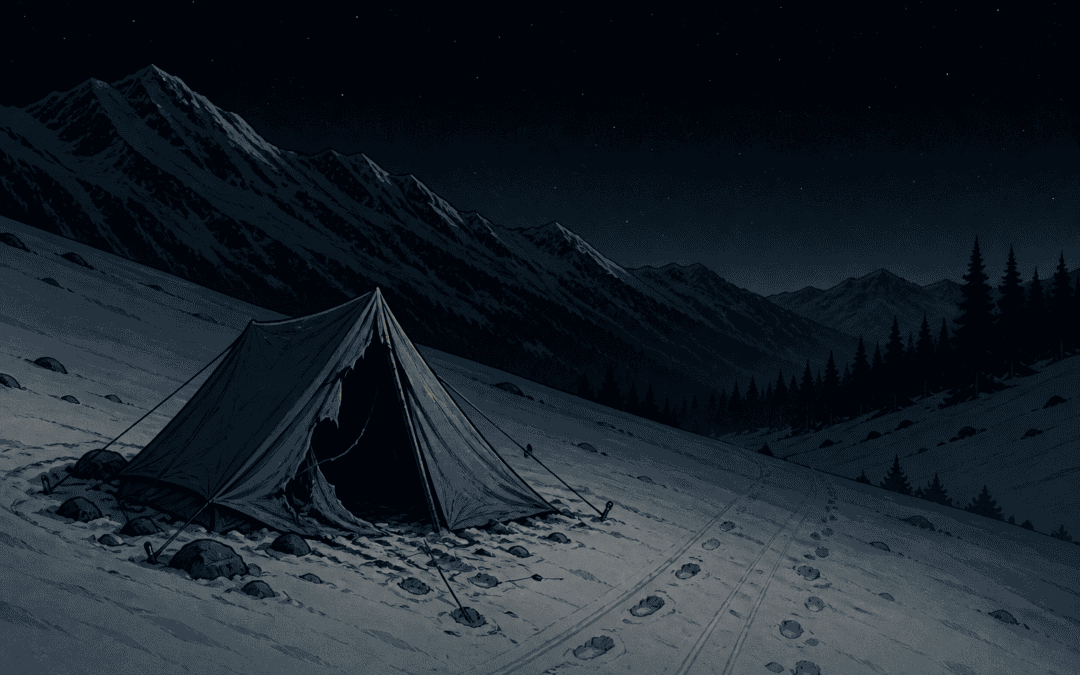
On February 1, the group set up camp on the slope of a mountain the Mansi people called Kholat Syakhl — which translates, again per multiple sources, to “Dead Mountain,” a name that predates this incident entirely and was not invented after the fact, for what that’s worth. When they failed to check in as scheduled, a search was launched, and on February 26, searchers found the group’s tent, cut open from the inside, abandoned, with most of the hikers’ belongings, boots, and warm clothing still left behind.
What Searchers Actually Found
This is where the case stops being merely tragic and starts being genuinely baffling, so let’s go through it carefully, because the details matter more than any single dramatic summary.
Footprints, made by people wearing only socks, a single shoe, or bare feet, led away from the tent down the slope — in February, in the Urals, in conditions well below freezing. Whatever happened, it happened fast enough and felt urgent enough that a group of experienced winter hikers left their tent, in the snow, at night, without properly dressing first. That detail alone is the seed of every theory that follows: something made them prioritize immediate flight over the basic survival instinct to grab boots and coats.
The first two bodies were found near a large cedar tree at the forest’s edge, about a mile from the tent, in only their underwear. The tree had broken branches up to five meters high, suggesting one or both had climbed it — searching for something, or fleeing something, at height. Three more bodies were found between the tree and the camp, apparently having died attempting to return to the tent. The remaining four bodies weren’t found until May, buried under meters of snow in a ravine further into the forest, and it’s this final group where the case takes its darkest turn: some had major physical trauma. One had major skull damage. Two had severe chest fractures consistent, according to Soviet investigators at the time, with the kind of force involved in a car crash — without any corresponding external wounds, bruising, or broken skin. In other words: internal trauma severe enough to be compared to a vehicle collision, with no visible cause. One member was missing her tongue, eyes, and part of her lips, though this detail is now widely attributed to natural decomposition and predation given the extended time her body spent partially submerged in a stream before recovery, not to any external attack.
The Soviet investigation at the time officially closed the case citing “a compelling natural force” as the cause of death, without further specifying what that force was — an almost comically unsatisfying conclusion for a state investigation to formally submit, and one that’s fueled speculation ever since. Some reports also noted elevated radiation levels on a few of the hikers’ clothing, though the significance and even the reliability of this detail has been disputed in later reviews.
The Theories, Ranked by How Seriously We Take Them
Avalanche (most credible mundane theory). A 2019 investigation by Russian prosecutors, followed by a widely-cited 2021 study published in Communications Earth & Environment, proposed a specific, unusual type of slab avalanche that could explain the tent damage and the group’s panicked flight, using modern snow-slope modeling and local topographical data. The theory has a real answer to the “why didn’t they see it coming” problem too: this wasn’t a Hollywood avalanche roaring down a mountainside — it would have been a smaller, delayed slab release, hours after they’d cut into the slope to pitch the tent, which is consistent with why experienced hikers wouldn’t have anticipated it. This theory also offers a genuinely plausible mechanism for the severe unexplained internal injuries: a compacted snow slab can deliver blunt force trauma without leaving external wounds, in a manner that could plausibly be compared to a car accident. This is, as of the most recent serious scientific literature, the leading credible explanation.
Katabatic wind / infrasound panic. An alternative theory proposes a specific local wind pattern around the mountain’s shape could have generated infrasound — sound below the range of human hearing that’s documented in some research to cause feelings of dread, disorientation, and panic in people exposed to it — potentially explaining why a group of experienced hikers fled their tent in a genuine, immediate, almost irrational hurry. It’s a real, physically grounded phenomenon, though critics note the theory struggles to fully account for the specific severe injuries found on some bodies.
Military testing / cover-up. Given the era, the location’s proximity to sensitive Soviet military test areas, and the lingering radiation detail, some researchers have proposed the group either witnessed something the military didn’t want witnessed, or was affected by a weapons test gone wrong, with the official investigation closed vaguely specifically to avoid admitting it. This theory is unfalsifiable in the specific way most cover-up theories are — the lack of hard evidence is used as proof of the cover-up’s effectiveness, which is a logically shaky foundation no matter how emotionally compelling it feels given how genuinely strange the state’s own non-answer was.
Yeti / cryptid attack. Yes, this theory exists, and yes, we have to mention it because it’s this site’s whole reason for existing, but we’d be lying to you if we pretended it holds up against the avalanche/blunt-trauma evidence as well as the mundane explanations do. We’re including it for completeness, not conviction.
What We Actually Think
We think the 2021 avalanche-slab study is the strongest candidate on the table, and it’s the rare “boring” explanation that actually accounts for the specific, weird physical evidence — the tent cut from inside, the panicked underdressed flight, and the severe unexplained internal trauma — rather than requiring you to hand-wave any of it away. But we also think it’s worth being honest that “strongest candidate” isn’t the same as “case closed,” particularly for anyone who’s lost family wanting a fuller answer than a modeled snow-slab scenario sixty-five years after the fact.
This is the one entry on this site where we’re less interested in being funny about the mystery and more interested in just making sure the actual story — nine real people, a genuinely bizarre scene, and a scientific community still actively working the case in 2021, not 1959 — gets told accurately. Sometimes the most respectful thing you can do with a genuine tragedy is take the science seriously and let the humor sit this one out.
Next up: we’re ranking. Every major Bigfoot sighting, judged strictly on plausibility, no sacred cows.