
Filed under: Case Files | Cryptid Cynic
Every cryptid has a hook. Bigfoot’s hook is “big, hairy, shy.” The Loch Ness Monster’s hook is “old lake, big lake, murky water, use your imagination.” Mothman’s hook is considerably weirder and, frankly, more disturbing: a red-eyed, winged humanoid that showed up in a small West Virginia town for about thirteen months, terrified a string of ordinary people, and then — this is the part that actually separates Mothman from every other cryptid on this list — was allegedly connected to a real, deadly disaster that happened right after it left.
That’s not normal cryptid lore. That’s the plot structure of a horror movie, except it happened, on the record, to real people, in Point Pleasant, West Virginia, starting in November 1966.
The First Sighting (Or: A Bad Night for Two Couples)
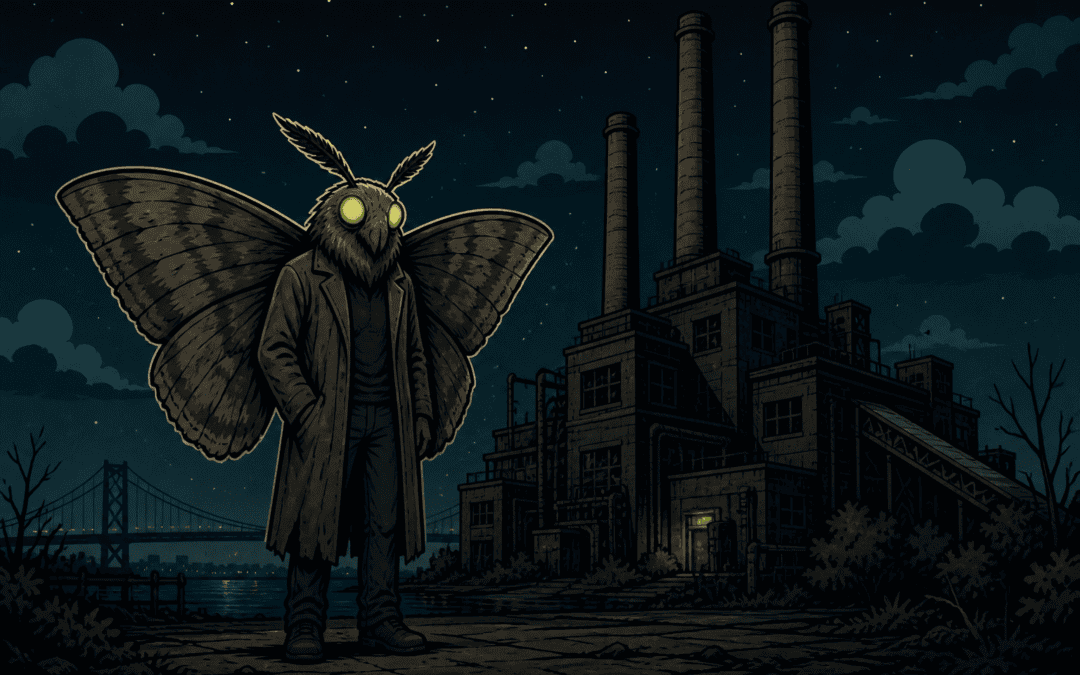
On November 15, 1966, two young couples — Roger and Linda Scarberry, and Steve and Mary Mallette — were driving through an abandoned World War II munitions site known locally as the “TNT area,” just outside Point Pleasant. According to their account, they saw a large gray figure with glowing red eyes standing near an old power plant building. When they tried to drive away, they claimed the creature followed — not by walking, but by flying, low over their car, at speeds they estimated (almost certainly with some panic-inflated math, and we’ll get to that) at up to 100 miles per hour, without ever flapping its wings.
They went straight to the local sheriff’s office, visibly terrified, which is itself worth noting — these weren’t people looking for attention or trying to sell a story. They were, by every contemporary account, badly shaken. The sheriff’s deputies searched the TNT area and found nothing, but the story got out, and within days, more sightings started rolling in from other locals: similar descriptions, similar location, similar overwhelming sense of dread that witnesses struggled to articulate beyond “something was very wrong.”
What Was It Supposed to Look Like?
Strip away the mythology and the eventual movie adaptation, and the core description across most 1966-67 witnesses is remarkably consistent: a humanoid figure roughly six to seven feet tall, gray or brown in color, with large wings folded against its back, and — the detail everyone remembers — glowing red eyes, sometimes described as set unusually, without a distinct head, giving the impression the eyes were mounted directly on the shoulders or upper torso. No mouth was ever reported. No sound, aside from an occasional described “squeak,” was consistently mentioned. It didn’t attack anyone. It didn’t touch anyone. It just showed up, stared, and sometimes followed.
That’s genuinely one of the stranger aspects of the whole case if you sit with it for a second: nearly every reported cryptid has an aggression narrative attached, even a mild one. Mothman’s entire behavioral profile across a year of sightings amounts to “appeared, watched, occasionally pursued a vehicle, left.” No attacks. No trace. No physical evidence. Just presence.
The Boring Explanation, Given Its Due
Before we get to the part where a bridge collapses and everyone loses their minds, let’s do our job and lay out the skeptical case properly, because it’s a genuinely strong one.
The leading rational explanation is that witnesses saw a large sandhill crane — a bird that, while not native to that specific part of West Virginia in 1966, can grow up to five feet tall with a nearly seven-foot wingspan, has reddish coloring around the eyes that can appear to glow under headlights (a very real phenomenon called eyeshine, common in many nocturnal or crepuscular animals), and has an genuinely unsettling appearance to someone who’s never seen one up close, at night, in an abandoned munitions site that already has a spooky reputation. A tired, adrenaline-flooded witness driving at night, catching a large unfamiliar bird in their headlights, is a very plausible mundane origin for at least some of these reports — and it lines up with the “no attack, no contact, just presence and pursuit” pattern, because startled large birds absolutely do erratic, fast movements near light sources and vehicles.
Mass hysteria and reporting contagion also deserve real weight here. Once the initial sighting became local news, Point Pleasant had every ingredient for a self-reinforcing scare: a genuinely spooky abandoned industrial site nearby, a tight-knit community where stories spread fast, and reporters actively soliciting more sightings once the story had legs. That combination reliably produces copycat and pattern-matching reports even when the underlying stimulus varies wildly — someone sees an owl, someone sees a barn owl’s asymmetrical face in shadow, someone’s imagination fills in “the Mothman” because that’s now the community’s shared vocabulary for anything unexplained at night.
The Part That Makes This Case Different
Here’s where Mothman stops being “large bird, small town, active imaginations” and becomes something people still argue about seriously.
On December 15, 1967 — thirteen months after the first sighting, almost to the week — the Silver Bridge, a suspension bridge connecting Point Pleasant, West Virginia, to Kanauga, Ohio, collapsed during rush hour traffic, killing 46 people. It remains one of the deadliest bridge disaster in U.S. history. The engineering cause was later determined: a single eyebar in the suspension chain failed due to a stress corrosion crack that had gone undetected — a real, mundane, tragic structural failure with a clear physical cause. There is no credible engineering theory connecting a cryptid sighting to a corroded steel eyebar. We want to be extremely clear about that up front.
And yet. In the aftermath, several Point Pleasant residents openly connected the two events, and that connection is what actually built Mothman’s cultural staying power far more than the original sightings did. Author John Keel, who had been investigating the sightings in real time throughout 1966-67 (his book The Mothman Prophecies became the basis for the 2002 film), argued that the entity’s appearances functioned as a kind of harbinger — not a cause, but a warning sign of coming disaster, tied into a broader personal theory Keel developed about “ultraterrestrials” and precognitive phenomena that, to be fair, gets considerably weirder and less rigorous than the core sighting reports themselves.
What We Actually Think
We think there are two entirely separate mysteries wearing the same trench coat here, and conflating them does a disservice to both. Mystery one: what did dozens of independent Point Pleasant residents see over thirteen months in 1966-67? We think “startled, misidentified sandhill crane plus small-town reporting contagion” is the most probable answer, and it’s not a cop-out — it’s a genuinely strong fit for the physical descriptions on record. Mystery two: why did a real, catastrophic, unrelated engineering failure happen in the same small town right as the sightings stopped, and why does that timing still give people chills fifty-seven years later? That one doesn’t have a satisfying answer, mundane or otherwise — it’s just an extremely uncomfortable coincidence that a community understandably struggled to process as “just a coincidence” after living through both events back to back.
Sometimes the honest answer to “was it real” is “the bird sightings were probably misidentification, and the disaster was definitely a tragedy, and the fact that your brain wants to connect those two things anyway says more about how humans process trauma and pattern-recognition than it does about moths, men, or omens.” Which, frankly, might be the most interesting takeaway of any case file on this site so far.
Next up: we put down the case files for a minute and get practical — the trail cams and EMF meters that’ll actually help you document something, instead of just giving you an excuse to stand in the woods at 2 AM.