
Filed under: Case Files | Cryptid Cynic
Every good conspiracy needs three ingredients: something strange happened, someone in power lied about it, and the lie kept changing every time someone asked a follow-up question. Roswell has all three, delivered with the kind of bureaucratic incompetence that would almost be charming if it weren’t allegedly hiding aliens.
Here’s the frustrating thing about Roswell: it’s simultaneously the most famous UFO story in American history and one of the most boring, if you take the government’s final explanation at face value. A weather balloon crashed. That’s it. Except the government took forty-seven years, three different official explanations, and one deeply strange classified program to arrive at that “boring” answer — and every time they explained it, they explained it slightly differently. That’s not how you explain a weather balloon. That’s how you explain something you’re actively trying not to explain.
What Actually Happened, As Far As Anyone Can Agree
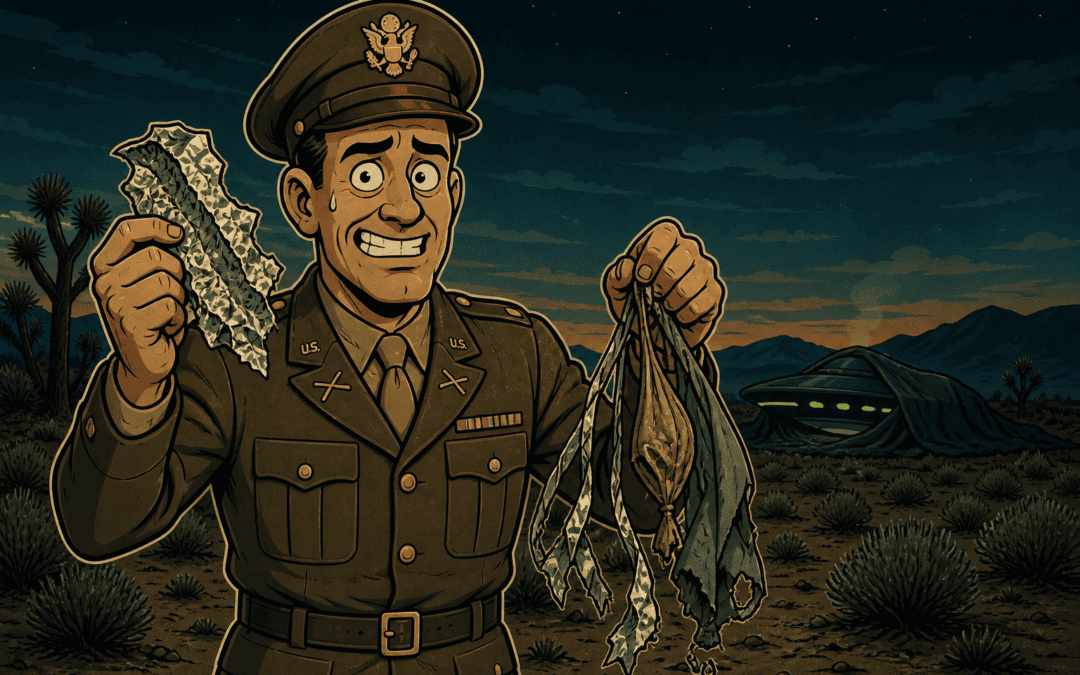
In early July 1947, a rancher named Mac Brazel found debris scattered across his property near Roswell, New Mexico — rubber strips, tinfoil, sticks, and unusually tough paper, all in quantities that struck him as odd enough to report. He brought some of it into town, word reached the Roswell Army Air Field, and on July 8, 1947, the base’s public information officer released a press statement that, if you’d asked us to write the worst possible PR move of the 20th century, we could not have done better: the Army announced it had recovered a “flying disc.”
Not a balloon. Not debris. A flying disc. In an official press release. From the United States military.
The story ran in newspapers across the country for one glorious day before the Army walked it back, insisting the wreckage was actually from a weather balloon, and released a photo of an officer posing with balloon debris to prove it. Most people accepted this at the time, because 1947 was a simpler era and also because “the Army says it was a weather balloon” was not yet a phrase that triggered instant suspicion. The story went quiet for over three decades.
Act Two: The 1970s Revival
Roswell as we know it today — the alien autopsies, the crash retrievals, the merchandise — didn’t really take off until the late 1970s, when researchers Stanton Friedman and William Moore began interviewing witnesses and military personnel who’d been at Roswell in 1947. What they found was a pattern that’s honestly more compelling than any single piece of physical evidence: multiple independent witnesses, decades later, describing debris with properties that don’t sound like a standard weather balloon at all — metal that couldn’t be cut, dented, or burned, that returned to its original shape after being crumpled, and markings on some fragments that witnesses described as resembling hieroglyphics rather than any printed English lettering.
Is “several elderly witnesses, decades after the fact, describing memories under intense researcher prompting” gold-standard evidence? No. Memory degrades, and leading questions from motivated researchers can absolutely shape recollection over that kind of timespan — we covered exactly this problem in our Bigfoot field guide, and it applies here with even more force given the decades involved. But “multiple people independently describing similar unusual material properties” is also not nothing, and it’s the kind of detail that a simple weather balloon narrative doesn’t explain away cleanly.
Act Three: The Government Changes Its Story. Again.
Here’s where Roswell stops being a story about a possible UFO and becomes a genuinely fascinating case study in institutional dishonesty, regardless of what actually crashed.
In 1994, facing decades of pressure and a formal inquiry from Congress (specifically from New Mexico Representative Steven Schiff, who got stonewalled enough by the Pentagon that he escalated it to the Government Accountability Office), the Air Force released a report. The new official explanation: the debris wasn’t from a standard weather balloon after all — it was from Project Mogul, a classified program using high-altitude balloon arrays to detect Soviet nuclear tests via acoustic sensors. This actually explains a lot: Project Mogul balloons used unusual materials (which could account for the strange metal and rubber strip descriptions) and the project’s classified nature would explain why the military was cagey and inconsistent about details in 1947 — they weren’t hiding aliens, they were hiding Cold War surveillance tech.
Then, in 1997, facing continued questions about witness reports of bodies and an “alien autopsy,” the Air Force released a second report claiming the “bodies” witnesses recalled were likely anthropomorphic test dummies dropped during high-altitude parachute experiments in the 1950s — which, if you’re paying attention, is a full decade after the original 1947 incident. The Air Force’s own explanation required witnesses to have conflated two entirely separate events from different decades in their memory. That’s not a smoking gun for aliens. But it is a genuinely bizarre explanation that requires its own leap of faith to accept at face value.
So to recap the government’s official position over fifty years: weather balloon → silence for thirty years → actually a classified acoustic surveillance balloon → also the bodies were crash test dummies from an unrelated decade-later program. If you’re trying to write the single most trustworthy possible cover story, this is not what it looks like. This is what it looks like when an institution is backfilling explanations for something it genuinely doesn’t want to fully explain — whether that’s because the truth is embarrassing (a failed, expensive secret surveillance program), or because the truth is something considerably weirder.
The Skeptical Case, Given Its Due
We’d be doing you a disservice if we didn’t lay out the boring-but-plausible version clearly, because it deserves real weight. Project Mogul was real. It was classified. It did use balloon trains with radar reflectors made of unusual foil and sticks that match witness descriptions of the debris disturbingly well. The military had every reason to be cagey and inconsistent in 1947 about a program meant to secretly monitor Soviet nuclear tests — national security secrecy, not extraterrestrial secrecy, explains a lot of the original confusion. Memory of extraordinary events, prompted decades later by researchers who want a specific answer, is a well-documented way to generate compelling but unreliable testimony. None of this requires aliens. Occam’s Razor, appropriately applied, points toward “embarrassing Cold War secret” long before it points toward “extraterrestrial visitation.”
So What Do We Actually Think?
We think the honest answer is the least satisfying one: something crashed near Roswell in 1947 that was unusual enough to generate a genuine, if brief, “flying disc” press release from the actual United States Army — that part isn’t speculation, it’s a matter of public record. What crashed was very likely classified military hardware, not a spacecraft. But the fifty years of shifting, contradictory, mutually-incompatible official explanations are their own separate mystery, entirely independent of whether aliens were ever involved — and that mystery is the part that actually deserves your skepticism, not toward believers, but toward the institution that kept changing its story every time someone asked a follow-up question.
Roswell isn’t proof of aliens. But it’s genuinely solid proof that if the government tells you something crashed and then spends five decades walking back the story in stages, you’re allowed to keep asking questions. That’s not conspiracy thinking. That’s just paying attention.
Next up: Mothman, the moth-shaped omen that showed up in Point Pleasant, West Virginia right before a bridge fell down — and nobody’s fully explained why.